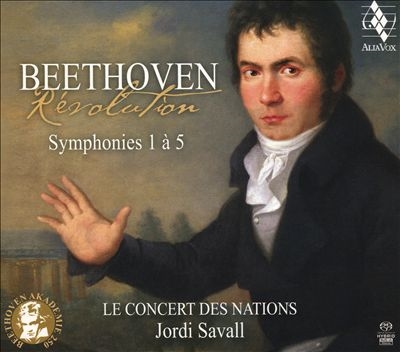
サヴァールによるベートーヴェン交響曲!
一挙に1-5番が登場!!
ベートーヴェン・イヤーに、ALIA VOXから注目盤の登場!この録音にあたり、サヴァールは当時使用された楽器、およびそれに近い楽器をそろえ、メンバー数も50-60名と当時なされていたと考えられるのと同じ規模で録音に臨みました。もちろんオリジナル資料にもあらためてあたり、ベートーヴェン自身によるテンポ表示などもすべて見直しての演奏となっております。全体を通して、良い意味で軽やかで、非常にピュアなまなざしで演奏していながら、思わぬ響きにはっとさせられる瞬間が続き、耳が開かれる思いです。美しさを追求した弦楽器の音色は抜群、管楽器のブレンド具合も見事。サヴァールのアンサンブルでおなじみのパーカッション奏者ペドロ・エステヴァンのティンパニも軽やかに響きながら全体を見事に引き締めております。交響曲第3番は1994年の録音がありますが、それ以来のベートーヴェン交響曲の登場ということで、大注目です。
キングインターナショナル
発売・販売元 提供資料(2020/07/28)
Given that Renaissance and Baroque specialist Jordi Savall is not necessarily the conductor to whom one would first turn for Beethoven, he is nevertheless a great musician whose opinion is worth listening to in any repertory. As one might expect, he has some unorthodox opinions in this survey of Beethovens first five symphonies (a complete set was planned but was at least temporarily cut short by the 2020 pandemic). Savall augments the 35 players of his Le Concert des Nations orchestra with 25 other young players for a total of 60, historically in line with what Beethoven would have expected. His tempos are blistering, based on the metronome markings from later in Beethovens career. Beethoven, however, did not own a metronome when he wrote most of these works; Savall is extrapolating from the later ones. Also, Beethovens metronome was a first-generation machine, and if one is to cite scholarly studies, as Savall does in his notes here, it is also necessary to cite the ones that have concluded that Beethovens machine was defective. The problem with taking the first movement of the Symphony No. 3 in E flat major, Op. 55 (Eroica) a good four minutes quicker than most other recordings on the market is, as conductors before Savall have found, that it leaves nowhere to go in the Presto-marked finale. This said, Savall has drilled his players very well, and the clarity achieved at these speeds in the outer movements is both remarkable and exciting. The speed combines nicely with the textures Savall generates. Like other historical-performance specialists, he is at pains to avoid what he called the hypertrophy of the strings, revealing many inner lines, but instead of blasting period brass (he actually tamps these down), his emphasis is on the percussion, which indeed supplies the Revolution element that Savall uses for his overall title. The finale of the Symphony No. 1 in C major, Op. 21, generates a good deal of exciting momentum in Savalls hands, and every time the Symphony No. 5 in C minor, Op. 67, seems ready to slacken even slightly, he drives the players forward with impressive results. The outer movements of the Symphony No. 2 in D major, Op. 36, and Symphony No. 4 in B flat major, Op. 60, have satisfying intensity, even if the Funeral March of the Symphony No. 3 is a rather aerobic funeral march. For those who buy the idea that Beethovens symphonies should be taken at these tempos, this will be a fresh and stimulating set. One awaits the final four symphonies as soon as they can be put on disc or hard drive.
Rovi