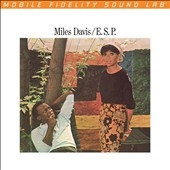
Jazz
SACDハイブリッド

E.S.P.

0.0

販売価格

¥
4,190
税込
ポイント20%還元

在庫状況 について

フォーマット SACDハイブリッド
発売日 2017年12月15日
国内/輸入 輸入
レーベルMobile Fidelity
構成数 1
パッケージ仕様 -
規格品番 MOFI2170SACD
SKU 821797217064

構成数 : 1枚
合計収録時間 : 00:48:33
Personnel: Miles Davis (trumpet); Wayne Shorter (tenor saxophone); Herbie Hancock (piano); Ron Carter (acoustic bass); Tony Williams (drums). Producer: Irving Townshend. Reissue producer: Mike Berniker. Recorded at Columbia Studios, Los Angeles, California from January 20-22, 1965. Originally released on Columbia (9150). Includes liner notes by Bob Belden. Digitally remastered using 20-bit technologyby Mark Wilder and Rob Schwarz (Sony Music Studios, New York, New York). Personnel: Miles Davis (trumpet); Wayne Shorter (tenor saxophone); Herbie Hancock (piano); Tony Williams (drums). Recording information: Columbia Studios, Los AngelesBob Cato (1965-01-20&1965-01-21&1965-). As Miles Davis' music evolved in the early '60s, he worked through aspects of his old repertoire, show tunes and the music of Gil Evans with a series of transitional bands, whose members dated from the late '50s on up. As he gradually assembled his dream band, the music began to take on a more modernist perspective, but it wasn't until he added saxophonist Wayne Shorter that this quintet finally gelled. E.S.P. marks the beginning of the quintet's collective evolution toward a new brand of modernism: freely inflected, with plenty of room for collective interplay, but still deeply rooted in chordal harmony and swing. After working with Hank Mobley, George Coleman and Sam Rivers, Miles finally got his man when Wayne Shorter left the Jazz Messengers to begin a five year stint with the trumpeter in 1964. The moody impressionistic chords Shorter penned to open "Iris" signal a new texture and harmonic palette for Miles' band, and his serpentine melodic invention, as epitomized by the title cut, acted as a creative catalyst for the entire band. Shorter went on to become the band's de facto musical director, but on E.S.P. Davis, Hancock and Carter all make significant contributions. "Eighty-One" presages Miles' growing interest in funky, blues-based materials, while "Agitation" features an evocative intro by 19-year old Tony Williams, already moving beyond simple choruses into layers of meter and texture, and followed by Davis, Shorter and Hancock's own jittery coiled solos.

  1. 1.[SACDハイブリッド]
    1. 1.
      E.S.P.
    2. 2.
      Eighty-One
    3. 3.
      Little One
    4. 4.
      R.J.
    5. 5.
      Agitation
    6. 6.
      Iris
    7. 7.
      Mood

作品の情報

メイン
アーティスト: Miles Davis

ゲスト
アーティスト: Wayne ShorterHerbie HancockRon CarterTony Williams

オリジナル発売日:1965年

商品の紹介

Down Beat (9/92, p.42) - 4 Stars - Very Good - "...E.S.P. marks the emergence of this band's unabashed impressionism with originals, the lovely, melancholic "Little One," "Iris," and "Mood" taking the balladic treatment to new heights..."
Rovi

ESP marks the beginning of a revitalization for Miles Davis, as his second classic quintet -- saxophonist Wayne Shorter, pianist Herbie Hancock, bassist Ron Carter, and drummer Tony Williams -- gels, establishing what would become their signature adventurous hard bop. Miles had been moving toward this direction in the two years preceding the release of ESP and he had recorded with everyone outside of Shorter prior to this record, but his addition galvanizes the group, pushing them toward music that was recognizably bop but as adventurous as jazz's avant-garde. Outwardly, this music doesn't take as many risks as Coltrane or Ornette Coleman's recordings of the mid-'60s, but by borrowing some of the same theories -- a de-emphasis of composition in favor of sheer improvisation, elastic definitions of tonality -- they created a unique sound that came to define the very sound of modern jazz. Certainly, many musicians have returned to this group for inspiration, but their recordings remain fresh, because they exist at this fine dividing line between standard bop and avant. On ESP, they tilt a bit toward conventional hard bop (something that's apparent toward the end of the record), largely because this is their first effort, but the fact is, this difference between this album and hard bop from the early '60s is remarkable. This is exploratory music, whether it's rushing by in a flurry of notes or elegantly reclining in Hancock's calm yet complex chords. The compositions are brilliantly structured as well, encouraging such free-form exploration with their elliptical yet memorable themes. This quintet may have cut more adventurous records, but ESP remains one of their very best albums. ~ Stephen Thomas Erlewine
Rovi

メンバーズレビュー

レビューを書いてみませんか?

読み込み中にエラーが発生しました。

画面をリロードして、再読み込みしてください。