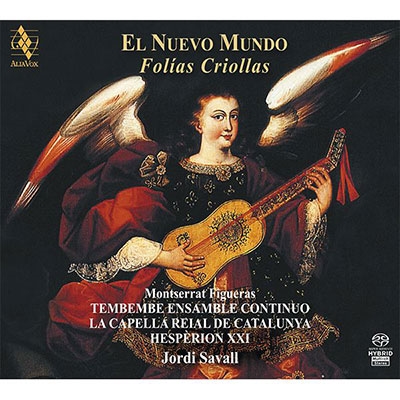
バロック時代に新世界で花開いた、魅力あふれる音楽の旅!
中南米にスペインの広大な植民地を建設する先鞭となった征服者コルテスによって、メキシコに最初に建設された港町がベラクルス。メキシコの海の玄関口として栄えたこの町には様々な人種があふれ、様々な民俗音楽が併存していました。その多様な音楽を吸収して、この町は開放的で表情豊かな民俗的な音楽を生み出しました。これとは別に、ヨーロッパのバロック音楽と、新世界に住んでいたインディオたちの音楽伝統が出会ったことで、このヨーロッパの伝統音楽は、魅力あふれる新しい色彩とリズムを獲得し、内的な豊かさを増しました。このアルバムは、これらの音楽を享受した中南米植民地生まれのスペイン人、クリオーリョたちの、多様で変化に富んだ魅力あふれる音楽世界を、旧世界の代表者たるサヴァールたち、そして、新世界の代表者たるテンベンベ・アンサンブルとともに旅する、刺激に富んだ録音です。
キングインターナショナル
発売・販売元 提供資料(2010/04/21)
This album takes off from where a previous Jordi Savall release, Villancicos y danzas criollas (Creole Dances and Villancicos), left off. Now Savall, aided by his wife and lead vocalist Montserrat Figueras, as well as several of his longtime co-conspirators, has formed a new group, Tembembe Ensamble Continuo, specifically devoted to the Latin American Baroque repertory heard here. The album is accompanied by an impressive 172-page booklet, with all texts in the original language, generally Spanish but with mixtures of Native American and African speech, English, French, Castilian Spanish, German, and Italian, and booklet notes (in all those languages plus Catalan), including an overview of the genres involved plus a historical essay on the culture of the Spanish-colonized Latin-Caribbean region. There's a lot to digest here, beginning with the fact that Savall is offering performances of music that has languished in archives for centuries, and he is doing it in a way that is going to rewrite the music history books. Yet this is far from a specialist release; the music is full of rhythms that approach those of present-day Latin genres, and the combination of these with ballad, comic, and religious texts from around the 17th century is endlessly fascinating. Even the Mexican standard Cielito lindo (although without its Frito Bandito refrain) is included. The basic ideas here are twofold. First, Savall has realized that Mexico, just like the U.S. Appalachians with the old English ballads, has preserved, both in archives and in traditional folk music, Spanish pieces that have disappeared in Spain and were never adequately preserved there. The second issue, and here is where Savall's percussion-heavy approach is really innovative, is that Spanish music, as performed and sometimes composed in Mexico and other colonies, interacted with the traditions of Africans and Native Americans. Some of the music is improvised, as it would have been three centuries ago, and when the string players get going over fairly complex polyrhythms you feel as though you're a step away from jazz. To get an idea of what this is all about, sample the pieces by Santiago de Murcia contained on track 5, which opens with a rock & roll-like rhythm. The cumbes, heard in the first part of this track, was the most African of the Spanish New World genres, and the harp-and-maraca music in the second half reflects on Native American contact. The traditional son jarocho, from the Veracruz region, is represented by several pieces; Los Chiles Verdes (The Green Chile Peppers, track 19) gives an idea of what was at stake between Native American women and their Spanish overlords, and of why so few people in Mexico today are either fully Native American or fully Spanish. Licentious as this piece is, there are also sacred pieces on the album, and they cohabit easily; the "Guineo" Rigor y repente of Gaspar Fernandes, track 11, contains Africanisms and might have been used in missionary activity. Savall hasn't made a dull recording in his life, but this particular strand of his output is especially persistently fascinating.
Rovi