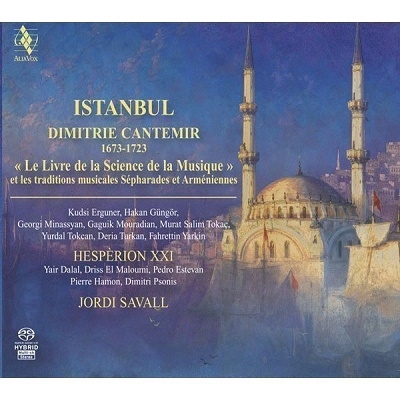
エルサレムの次はイスタンブール! サヴァールと音楽を旅する文明の十字路!
アルバム「東洋=西洋(1000-1600)」でも取り上げられたディミトリエ・カンテミル(1673-1723)は、大貴族の一族であったモルダヴィア公コンスタンティンの息子。10代半ばからモルダヴィア公になるまで居住したイスタンブールで、各国の歴史や言語(11ヶ国語を話し書けた)、東洋の音楽理論などを学び、トルコ音楽に関する論文を書いています。また、独自の記譜法を考案し、自作を含む数々の曲を書き残しました。
兄アンティオフの跡を継いでモルダヴィア公となりましたが、ロシア軍を包囲してトルコが勝利した1711年のプルート川の戦い(大北方戦争(1700-21年)の1局面)において、モルダヴィアに侵攻したピョートル1世軍に降伏したため、戦後ロシアに亡命し、ロシア帝国で公爵、宮廷顧問官として、後半生を過ごしました。モスクワに移ってからは、ラテン語でオスマン帝国史を書いたり、ルーマニア語でトルコ音楽入門を編纂したり、モルダヴィアの古い宮廷の習わしや民衆の伝統について編纂したりと、多方面への学術的関心、特にルーマニア音楽に関する貢献で、後世に知られています。
なお、手稿譜の名として定着しているカンテミルオウルはカンテミルのトルコ語での読みになります。「文字を使う表記法による音楽書」という題名のこの手稿には、自身の約40曲になる作品を含め、器楽曲が約350曲が収められており、オスマン・トルコ時代の貴重な資料となっています。
サヴァール率いるエスペリオンXXIは、文化的、音楽的に、西と東が、それまで保っていた同質性の点において離れ始めた瞬間を、イスタンブールという都市を通して、この手稿譜から7曲、タクシームという即興曲を8曲、他に、セファラードとアルメニアの伝承曲を取り上げ、今の我々の魂に響き渡らせてくれます。 [コメント提供;キングインターナショナル]
---
発売・販売元 提供資料
As is typical with every project he undertakes, Jordi Savall's album Istanbul: Dimitrie Cantemir "The Book of the Science of Music" and the Sephardic and Armenian musical traditions is beautifully executed, with lively, idiosyncratic performances informed by scrupulous research and collaboration with performers who are masters in their field. Cantemir (1673-1723) was one of the most exceptional and multitalented men of his time. He was twice briefly the Prince of Moldavia; a scholar in the fields of linguistics, ethnography, historiography, religion, philosophy, literature, and music, whose intellectual achievements were recognized in Eastern and Western Europe and in the Ottoman Empire, an advisor to Peter the Great of Russia, and a composer and virtuoso performer. He devised a notation system for Ottoman music and left a vast collection of transcriptions of existing and original compositions in The Book of the Science of Music. The recording includes music from that collection as well as Sephardic and Armenian music, played by members of Savall's ensemble Hesperion XXI and musicians from Armenia, Israel, Morocco, and Greece. The result is a fascinating and diverse sampling of the ways the musical traditions of cultures around the Mediterranean have complemented and influenced each other. The complex metrical patterns and the use of non-Western modes and instruments create a sound that may be exotic to most Western listeners, but the music is rhythmically energetic, often danceable, melodically accessible, and emotionally direct. The pieces vary widely in style, mood, and instrumentation, they are delicate, soulful, and sophisticated, and they are played with an infectious spontaneity. The sound of Alia Vox's SACD is transparent, vivid, and very present. The album should appeal to listeners with an interest in the music of the Near and Middle East and in the ways musical cultures intersect and interact.
Rovi