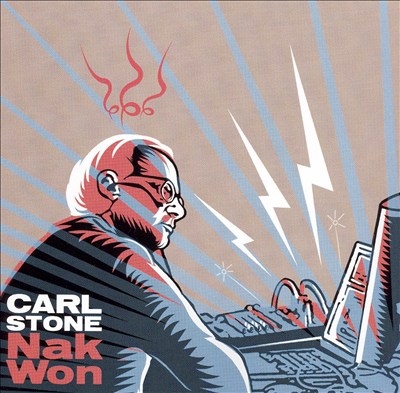
Veteran American electronic composer Carl Stone moved to Japan in 2001, where he writes for the Tokyo-based magazine Sound & Recording and teaches digital electronic music at Chukyo University. Nak Won, issued on the French/Japanese Sonore Records label, consists of some of the last pieces Stone composed in the United States before his departure for Japan; this program more or less follows one that Stone presented in Los Angeles not long before his departure. Prolific to a degree on CDs in the 1990s, Nak Won was the only solo release Stone produced in the early 2000s, even as his work in collaborations with others (such as pipa virtuoso Min Xiao-Fen) and live performances throughout the world remained constant. Nak Won consists of three long-form electronic pieces of which the outer two require a good deal of patient listening as their secrets only unfold over time, though Stone's unwillingness to compromise in this regard is a hallmark of his artistry.
The title track, Nak Won, is centered around a stubborn tone that sounds like an old frequency tester, moving up and down on the same pitch in different octaves. This sound is joined by distant, fractious elements placed far in the background that ultimately conjoin themselves into the main tone, creating a pleasing and atmospheric result for a time before it comes apart. Nak Won has the virtue of having a clear-cut formal structure and a sense of purpose. The second piece, Kreutz, is a very attractive ambient piece that unfolds through a series of subtly shaded chords.Darul Kabap begins with modified sounds from a stringed instrument -- possibly a pipa -- answered by similar sounds filtered in a different way, joined by another related, more purely electronic voice, and so on. While the entrances of these voices are carefully timed, the result resembles something of a free-form electronic jam as it goes along.
Stone utilizes a G3 Powerbook in realizing these works, and what he does with it is very musical; as such, listeners attuned to average "laptop band"-based noise might not get much out of Nak Won. Stone's work is primarily created with live performance in mind, and the disc, good as it is, can only be seen as partially representative of what he is up to. Nonetheless, Carl Stone remains a vibrant force in digital electronic music, and Nak Won is a worthy addition to his canon.
Rovi
Nak Won is a major addition to Carl Stone's discography. Released in late 2002 by the French label Sonore, it presents three pieces performed in real time on a laptop computer running Max/MSP software and recorded in various locations on the West Coast. A demanding program, possibly Stone's most uncompromising album to date, Nak Won is nevertheless highly rewarding. The title track, 24 minutes long, could have you a little worried at first. It starts like one of Sachiko M's sine-wave pieces. Arid at first, it slowly grows as the tones get chopped up and thrown around into the stereo field. A lush background of electronic noises swells at the midpoint, receding as activity decreases to complete what ends up being a cycle. "Kreutz" is very different. First of all, it reveals its sound source up front: a piano. More ambient, the music hovers delicately, like one of Ekkehard Ehlers' limping waltzes or Christian Fennesz's cloudy surf music reminiscences. But the highlight of this album is the half-hour "Darul Kabap." Here, Stone samples, breaks down, and reassembles an Arabian singer, traditional Chinese music, dance music, and a few more sources (Hans Reichel's daxophone at one point?) into a dizzying cut-and-paste race that brings to mind Ground Zero's Revolutionary Pekinese Opera. It never reaches that level of mind-boggling schizophrenia, but it makes a commanding effort trying and ends up (especially in the last ten minutes) sounding like Kid 606 minus the poise! ~ Francois Couture
Rovi