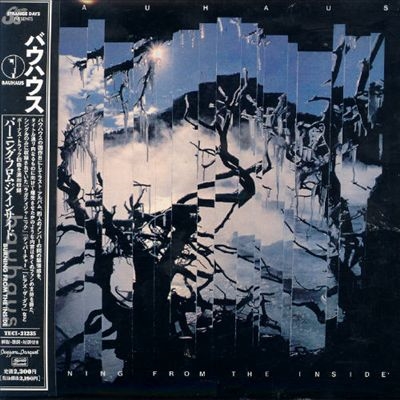
1983's BURNING FROM THE INSIDE is Bauhaus' most commercial-sounding album. It is arguably their most effective, and, sadly, their last album as a group, though numerous collections and live recordings have appeared in its wake. This album shows all of the group's strengths. Bauhaus creates an immediately identifiable 'mood' in the mind of the listener, as in the opening track ("She's in Parties"). They have an uncanny knack for revealing massive, dense beats in the middle of what would be, in others' hands, straight-ahead rock songs. Bauhaus also has a unique ability to wring poignancy and nostalgia out of the weirdest lyrical constructs--as in the album's centrepiece, "Who Killed Mr. Moonlight", introduced by piano and mournful saxophone.
The album originally ended with "Hope", a brilliant three-minutes that advises "Make the most of a million times no" with choral vocals, a gorgeous, thick bassline, and a shimmering guitar. The CD adds several bonus tracks from singles, including the brutal dance groove of "Lagartija Nick". One of Bauhaus' most distinctive and successful singles, this darkly gleaming jewel showcases the group's trademark echoed vocals and Kevin Haskin's uncommonly precise drumming with cool horn section inserts.|
Rovi
If The Sky's Gone Out felt like a collection of various recordings, Burning from the Inside really was, due in large part to outside events -- Murphy had fallen victim to a life-threatening illness, so the rest of the band began recording without him, which more than anything else foreshadowed both Bauhaus' breakup and the trio's future work as Love and Rockets. As a result, two songs ended up on the album, the piano-led cinematic moodiness of "Who Killed Mr. Moonlight" and the sweet acoustic drive of "Slice of Life," with David J and Ash on lead vocals respectively. Furthermore, more songs from the earliest days of the band were dug up to provide material, the most notable and successful being the dub-inflected, heavily dramatic "She's in Parties," using filmmaking as a metaphor for romance and life, with Murphy's excellent lead balanced against a near-whispering chorus from the other two singers. The end result of all this was an album that was good in spots but not as strong throughout as it could be, while betraying the other performing and writing strains that would soon cause the band to call it a day. As before, though, when the band members were on, they were on with a vengeance, such as the medieval folk dance "King Volcano" and the starkly beautiful "Kingdom's Coming." The ten-minute title track takes a good idea and stretches it out a little too long, but the concluding track "Hope" follows it with a life-affirming, inspirational vibe that serves as much as a farewell for Bauhaus' audience as anything else. While imperfect, Burning from the Inside has much more to recommend it than many other albums. ~ Ned Raggett
Rovi
メンバー間の緊張感が感じられるスリリングな作品。
1983年度作品。