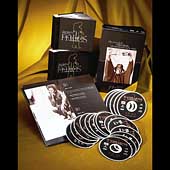
| フォーマット | CDアルバム |
| 発売日 | 2002年10月15日 |
| 国内/輸入 | 輸入 |
| レーベル | Legacy Recordings |
| 構成数 | 20 |
| パッケージ仕様 | ボックス |
| 規格品番 | 86824 |
| SKU | 696998682429 |
構成数 : 20枚
合計収録時間 : 00:00:16
Personnel includes: Miles Davis (trumpet, organ, keyboards); Quincy Jones (conductor); Chaka Khan (vocals); Dave Liebman (soprano & tenor saxophones, flute); Kenny Garrett (alto saxophone); Rick Margitza (tenor saxophone); Bob Berg (saxophone, keyboards); David Sanborn (saxophone); Wallace Roney (trumpet, flugelhorn); Robert Irving III, Adam Holzman, Kei Akagi, Deron Johnson (keyboards); J. Mtume (synthesizer, congas, percussion); George Duke (synthesizer); Pete Cosey, John Scofield, Reggie Lucas, Robben Ford (guitar); Michael Henderson, Daryl Jones, Felton Crews, Foley, Richard Patterson(bass); Al Foster, Vincent Wilbrun, Jr., Ricky Wellman (drums); Steve Thornton, Marilyn Mazur, Munyungo Jackson, Erin Davis (percussion); Gil Evans Orchestra.
Recorded live at Montreux Jazz Festival, Montreux, Switzerland between 1973 & 1991. Includes liner notes by Nick Liebmann.
Columbia Records has been diligent about going through Miles Davis' massive catalog, painstakingly remastering and reissuing his collected works in both handsome box sets sorted by period and actual releases annotated with extra material from their attendant sessions, but this gargantuan set marks a true departure for them. The Complete Miles Davis Live at Montreux 1973-1991 compiles 20 CDs documenting every performance by the trumpeter at the famed Swiss jazz festival in its entirety. What's more, 19 of these volumes have never before been issued in any form. Aside from disc 19, which features the Miles band playing acoustically in front of a large orchestra conducted by Quincy Jones in 1991 (which was released by Warner Bros.) and a few selected cuts tacked onto other recordings, none of this material has seen the light of day anywhere. There is a story told here, one that streams light into the darkened corners of Davis' final public period, and one that challenges evidentially virtually every jazz nerd's view that as a bandleader or as a creative improvisational force, Davis was finished after the release of On the Corner. Part of that story is the intuitive sense Davis had of the bandstand and what could be accomplished there. His uncanny ability to pick the finest musicians for the job at hand was illustrated by his stage direction. Another argument for this material is that, even if it doesn't vindicate the studio material of the time, which is rightfully thought of as inferior to his earlier work (with the possible exceptions of the Decoy and Tutu albums), it at least justifies it; these recordings can now be seen as piecemeal explorations of what might be possible in concert settings -- not as rehearsals, but as source material. Lastly, as documented here, Davis accomplished everything he set out to do, which was to take the sophistication of jazz, the accessibility of pop, and the sheer groove of R&B and funk, to create a new American music that was familiar and challenging. Also, that virtually everything here comes off as emotionally honest, even painstakingly so, is a testament to the heart of the musician and, yes, the man.
Discs one and two from 1973 represent Miles' first and only appearance during that decade at Montreux -- represented by two full sets. The band was a stellar one: the Dark Magus band, featuring saxophonist Dave Liebman, guitarists Reggie Lucas and Pete Cosey, drummer Al Foster, new bassist Michael Henderson, and percussionist Mtume. The rest of the material picks up at the end of the infamous "silent years," exactly 11 years later in 1984, and moves through to the virtual end -- a bonus to the set is a concert in Nice just before the trumpeter died (there are a pair of California dates that are later, but these will be forthcoming at a later date). The 1973 date embodies the epitome of the dark, swirling funk of Davis' best '70s material. Here Henderson adds something new to the rhythm section in that he is not a jazz player, but a funk player swiped by Davis from the Stevie Wonder band. His long chunky repetitive riffs are exact
録音 : ステレオ (Live)
読み込み中にエラーが発生しました。
画面をリロードして、再読み込みしてください。