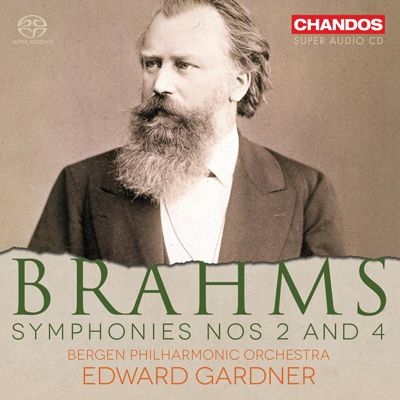
洗練された演奏とサウンドが光るガードナー&ベルゲン・フィルのブラームス:交響曲全集、6年の年月を経て完結!
2015年から24年までベルゲン・フィルの首席指揮者を務め、2025年のGramophone Awardsでオーケストラ・オヴ・ザ・イヤーに輝くまでに導いたガードナー。2018年に録音、翌年リリースされた第1番&第3番(CHSA5236)以来、長く待ち望まれていた交響曲全集完結編の登場。2023/24シーズンで首席指揮者を退任したガードナーとオーケストラにとって、当シーズンの最後に録音された第4番の演奏には特に深い思いがあったものと思われます。バランスよく整えられたサウンドから生まれる透明感、誇張やテンポの揺れを抑えた流れの良さなど、作品の良さをそのままに届けようとする演奏で、2025年秋に読響を指揮したブラームスの第1番に通じます。ガードナーは在任中の功績が評価されてベルゲン・フィルから名誉指揮者の称号が贈られました。これからも共演が続くであろうこの名コンビの、記念碑の一つとなる録音です。
ナクソス・ジャパン
発売・販売元 提供資料(2025/11/21)
The symphonies of Brahms remain particularly demanding territory for conductors, and more than a century after their creation, they continue to inspire widely differing interpretative approaches. In this recording devoted to Symphonies Nos. 2 and 4, Edward Gardner and the Bergen Philharmonic Orchestra offer a performance that explores the subtleties of Brahmss musical language while emphasizing clarity and flexibility of musical line.
The recording opens with the Symphony No. 2 in D major, a major work of the Romantic repertoire that benefits here from Gardners fluid and accessible interpretation. To preserve the balance between orchestral density and structural clarity, Gardner adopts natural tempi and avoids the kind of overt sentimentality that can easily weigh down Brahmss musical discourse. The first movement, the longest in the program, unfolds in a luminous, pastoral atmosphere, with textures that remain airy and breathing under the warm strings of the Bergen Philharmonic. At times, however, this consistent pursuit of brightness slightly softens the expressive density that some conductors choose to emphasize in the work. The second movement reveals more clearly the introspective depth of Brahmss language. Here, Gardner establishes a tension that is discreet yet constant, allowing the melodic lines to emerge with considerable elegance and fluidity. The phrasing remains supple and well-shaped, giving the music an almost mesmerizing intimacy. The third movement, lighter and more sparkling in character, benefits from precise articulation, almost surgical in its clarity, and a particularly lively rhythmic sense, contrasting with the finale, which returns to the orchestral density and expressive energy of the opening, even if the dramatic impulse occasionally feels somewhat restrained under Gardners baton.
The Symphony No. 4 in E minor, a darker and more structurally rigorous work, gives Gardner the opportunity to explore a different expressive palette. From the opening measures, the orchestra produces a sonority that is both dense and transparent. Gardner places particular emphasis on the clarity of Brahmss contrapuntal writing, successfully avoiding the heaviness that can sometimes affect performances of this work. This approach carries into the second movement, supported by expressive woodwinds and darker-toned strings. Throughout this expansive movement, the conductor sustains a subtle tension that prepares effectively for the eruption of the third movement, delivered with remarkable rhythmic precision and carefully controlled power, revealing the full vitality of Brahmss orchestral writing. It is ultimately in the famous passacaglia finale that the recording reaches its high point. Gardner demonstrates a keen understanding of Brahmss architecture, paying close attention to orchestral color while shaping the variations with an organic sense of progression that allows the works internal tension to unfold naturally. The result highlights the almost architectural character of the movement, even if some listeners might prefer a more sharply defined or dramatic approach in the final variations.
This recording confirms the strong artistic rapport between Gardner and the Bergen Philharmonic. Their collaboration results in a performance distinguished by its clarity, balance, and sincerity, doing full justice to two of the most emblematic symphonies of the Romantic repertoire. ~ Islem Meghiref
Rovi