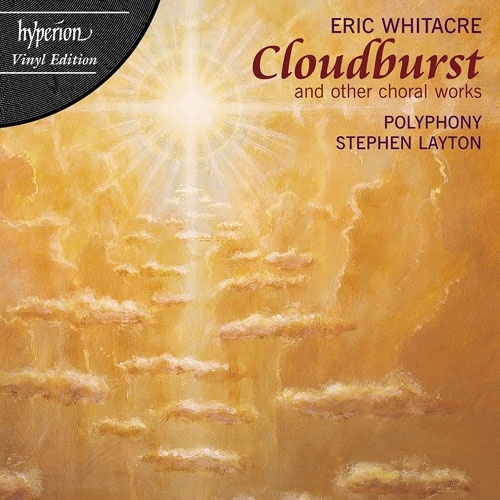
イギリス合唱界の名指揮者スティーヴン・レイトンと合唱団「ポリフォニー」はこれまで何年もハイペリオンと優れた合唱録音を行ってきましたが、このエリック・ウィテカーの『クラウドバースト』とその他の合唱作品集を収録したアルバムは格別です。「BBCラジオ3」は「驚異的」と表現し、『ザ・タイムズ』紙は「勝者である」としました。この象徴的なグラミー賞ノミネート・アルバムは、ウィテカー独自の作曲法を世界中の観客に紹介しました。
※180g重量盤、Gatefold仕様
ユニバーサル・ミュージック/IMS
発売・販売元 提供資料(2025/06/25)
This disc was a bestseller straight out of the box, one of a precious few collections of new music by a contemporary composer of which that might be said. Eric Whitacre is a fifth-generation Nevadan who couldn't read music when he enrolled at the University of Nevada at Las Vegas. On his first day in the choir, which he joined because of some pretty girls in the soprano section, they rehearsed the Kyrie from Mozart's Requiem -- and, says Whitacre, "My life was profoundly changed on that day, and I became a choir geek of the highest order." He began to write choral music that drew on the styles of the man who became his teacher, John Corigliano, and on the minimalist choral works of Arvo Part and John Tavener without sounding much like any of them. His music is marked by unusual choral effects including, most characteristically, a fleeting, shimmering use of dissonance, with sequences of what might be called micro-resolutions. The music is accessible to any listener, consonant but not really tonal, and driven by close attention to a wide variety of poetic texts, for which Whitacre devises unique forms of declamation. The longest work on the album is a setting of the Bible verse beginning "When David heard that Absalom was slain..." with much of the duration given to crystalline, shifting, very moving repetition of the words "my son." All of the music on this disc is a cappella except for the title track.
Other works set poems by Emily Dickinson, e.e. cummings, Octavio Paz (in a mixture of Spanish and English), Federico Garcia Lorca, Edmund Waller, and various contemporary writers. Whitacre's sensitivity to these texts alone raises his music well above the norm, and his instinct for choral writing adds to the interest of these short works. His work is more rigorous than Rutter's, less mystical than Part's, and choral singers and directors who haven't heard Whitacre yet need to make it their business to do so soon. Polyphony, an English choir with an ear for outstanding American choral music, delivers beautifully shaped lines, clear text articulation, and clean execution of Whitacre's little clusters of tones that resolve themselves into patterns as if an aural kaleidoscope were slowly turning. The sound environment, as usual with Polyphony, is perfectly suited to the music. Cloudburst deserves every bit of its considerable success.
Rovi