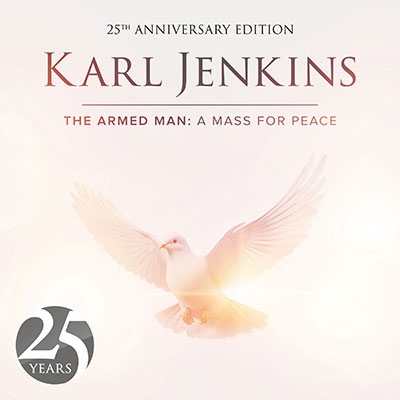
初演から25周年記念。カール・ジェンキンスが"次のミレニアム"へ平和な未来を託した作品
《カール・ジェンキンス~The Armed Man: A Mass For Peace》
イギリスの作曲家カール・ジェンキンス(1944-)によるアルバム『The Armed Man: A Mass For Peace』(2001年発表)がデッカより発売されます。このアルバムはイギリスの国立武器防具博物館「ロイヤル・アーマリーズ」により、ミレニアムが次のミレニアムへと移行することを記念して委嘱された作品です。「人類の歴史の中で最も戦争によって荒廃し、破壊された世紀」が過ぎつつあることを映し出し、希望を込めてより平和な未来へと向かうことを願います。『The Armed Man』は作曲中に悲劇が繰り広げられたコソボ紛争の犠牲者たちに捧げられています。2000年にロンドン・フィルハーモニー管弦楽団とイギリス・ナショナル・ユース合唱団により、ジェンキンス自身の指揮で初演されました。ジェンキンスと「ロイヤル・アーマリーズ」の館長であるガイ・ウィルソンの二人が共に歌詞を選びました。作品全体は伝統的なカトリックのミサの形をとり、「キリエ」「サンクトゥス」「アニュス・デイ」「ベネディクトゥス」が含まれています。その中の一部は「ClassicFM」などで独立した人気曲として聞かれていますが、何といってもこの作品の特徴は、世界各地や多様な宗教と文化からとられたそれらの歌詞であり、音楽もまたその着想が非常に世界的な視野に立ったものとなっています。
初演から25周年となるのを記念して、アルバムのカバーが新たにデザインされ、「ロイヤル・アーマリーズ」の館長ガイ・ウィルソンによる委嘱の経緯、寄稿者の新たな経歴、ジュリアン・ロイド・ウェバーからの初演についての新規エッセー、さらにカール・ジェンキンス自身によるエッセーも掲載されています。
発売・販売元 提供資料(2025/04/25)
Karl Jenkins, a British composer who has written award-winning music for advertising, created this choral work for the Royal Armouries, a museum of medieval military objects housed in the Tower of London. The idea, writes the museum's director, was to use the medieval tune L'homme arme (The Armed Man) to create a modern mass, just as composers of half a millennium ago did with some frequency -- and thus "to look back and reflect as we leave behind the most war-torn and destructive century in human history." L'homme arme is a little scrap of music saying basically that "the armed man must be feared." No one really knows why it was so popular in its day, but one theory is that it referred to the mustering of forces that followed in the wake of the fall of Constantinople (now Istanbul) to Islamic forces in 1453.
There's nothing in the individual sections of music here that you haven't heard a dozen times in film or television scores, and Jenkins is one of those crossover composers who feel the need to put down those who attempt music of a different kind. It's especially classless of him to disrespect John Cale, who played the viola when Jenkins was an oboist with the Wales National Youth Orchestra and who will be remembered long after The Armed Man: A Mass for Peace has fallen off the charts. Nevertheless, Jenkins' work gets points for sheer ambition, and it's easy to understand the tremendous popularity it has attained in Britain -- it has been programmed by community choirs all over the place. Jenkins does not weave L'homme arme into a flow of polyphony as a Renaissance composer would have done. Instead, he bookends the work with two different treatments of the tune (whose title is mispronounced by the National Youth Choir of Great Britain). In between come parts of the Ordinary of the Mass (the Gloria and Credo are missing), interspersed with other texts pertaining to war and its horrors: a Japanese poem about the firestorms that followed the atomic bombs, Rudyard Kipling's "Hymn Before Action," and an apocalyptic passage from India's Mahabharata. Those who already love this work would be advised to check out Leonard Bernstein's Mass, a similar sort of piece that achieves much more variety and more of a sense of genuine surprise. But Jenkins does manage to weave disparate sources together into a coherent and compelling whole. The Armed Man is much less well known in the U.S. than in Britain, probably because the U.S. crossover market is smaller than Britain's and more oriented toward singers.
Rovi