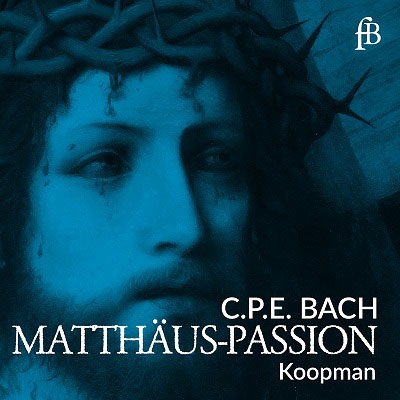
トン・コープマンによるマタイ受難曲!
2002年ウィーンでの名演が復刻!
「Fra Bernardoレーベル」の「Early Music Logシリーズ」は古楽を理解するための重要なポイントとなる節目を提示していくことを目的としています。ブックレット内のQRコードからドキュメンタリーにリンクできるようになっています。
1767年、C.P.E.バッハは名付け親であるゲオルク・フィリップ・テレマンの後を継いでハンブルクの音楽監督に就任しました。その2年後、彼は毎年恒例の受難曲集の最初の作品となる「マタイ受難曲 H. 782」を披露しました。この作品は、終戦後長い間失われたと考えられていましたが、1999年にキエフのベルリン・ジングアカデミーの音楽アーカイブで再発見され、2002年にトン・コープマンによって初めて演奏されました。この作品は、父の記念碑的な受難曲の遺産を受け継ぎながら、啓蒙時代の神学的・音楽的感性の変化も反映しており、まさに2つの音楽時代の架け橋となった注目すべき作品と言えるでしょう。
本アルバムでは、名匠トン・コープマン率いるアムステルダム・バロック管弦楽団、そして、名ソリストたちによって残された、ウィーンのミノリーテン教会での感動的なコンサート録音が復刻します。
東京エムプラス
発売・販売元 提供資料(2025/04/03)
Carl Philipp Emanuel Bach, as part of his regular duties as kapellmeister in Hamburg, composed 19 passion settings, alternating the four Gospel texts so that a new setting of a given text appeared once every four years, as his predecessor Georg Philipp Telemann had done. Until the discovery of the Berlin Sing-Akademie collection in Kiev in 1999, all that remained of this considerable body of work were bits and fragments of individual pieces, most of them extant because they were used in other contexts. One of the very initial projects resulting from the Sing-Akademie materials, which has since given us Vivaldi's opera Montezuma and Johann Mattheson's Boris Godunov, was the first revival ever of C.P.E. Bach's incipient foray into passion settings, his Matthaus-Passion of 1769. Presented on the ORF Alte Musik imprint by the forces that premiered the work, this is a live recording made in 2002 at the Minoritenkriche in Vienna featuring soloists, chorus, and the Amsterdam Baroque Orchestra under the direction of Ton Koopman.
This particular passion setting was achieved by Bach with great effort, and under no small amount of duress; he was named kapellmeister at Hamburg in the wake of Telemann's death in 1767, but did not have a passion ready for 1768 and one of Telemann's settings had to be repeated. While Bach had participated in the first performance of his father's masterful St. Matthew Passion in 1729, he was unfamiliar with the considerably more modest requirements for the passion in Hamburg versus Leipzig 30 years earlier, and liturgical tastes had changed considerably since the advent of his father's masterpiece. In writing this work, and most of the other passions to follow, C.P.E. Bach relied on modeling to help him get the unwieldy-no-matter-what-text-is-used passion setting in under the deadline. Listeners may note snatches here and there lifted from Johann Sebastian Bach's St. Matthew Passion and those savvy enough to know Carl Heinrich Graun's cantata Der Tod Jesu may recognize some borrowings from that work as well.
So, does the 1769 Matthaus-Passion operate at the level of unquestioned C.P.E. Bach choral masterworks as the oratorios Auferstehung und Himmelfahrt Jesu or Die Israeliten in der Wuste? Not quite -- it does not manage, in the end, to transcend the patchwork manner of its creation; there are long sections of obligatory-sounding recitative, particularly toward the beginning of the work, that are less than compelling. Nevertheless, in certain parts it really "wakes up," particularly around the aria "O Petrus, Petrus, folge nicht" up through the soprano duet "Muster der Geduld und Liebe." Another good reason to want this is the fine performances by tenor Jorg Durmuller and Klaus Mertens; while ladies Deborah York and Franziska Gottwald also do a good job here, the men steal the show. The playing by the Amsterdam Baroque Orchestra under Koopman is spirited and crisp; the live recording is clear, but a tad quiet -- one will want to crank it up a bit.
Rovi