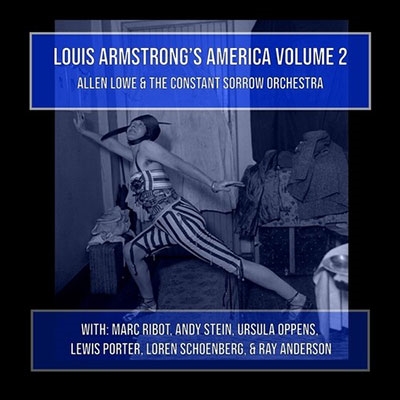
Neither of saxophonist/composer Allen Lowes two-volume, four-disc Louis Armstrongs America contains compositions by their subject or tunes associated with him. Given the massive scope of Lowes earlier musical, scholarly, and authorial work, that isnt surprising. This ambitious undertaking contains 69 tracks composed by Lowe as an expression of an "older American musical aesthetic, sensibility and cultural consciousness…" It reflects Armstrong being influenced by, and later influencing American popular music, as seen through the lens of his own life and Black cultural experience. Lowe argues that Armstrong is the first post-modernist, who chose from a wide variety of musical sources (minstrel show, pop, opera, blues, the Beatles James Brown, and Ornette Coleman) without regard for culture, class, or racial hierarchies. Lowes tunes reference and namecheck historic periods and personas from swing and ragtime to bop, modal music, and more. In his copious liner notes and track annotations, he cites Duke Ellington, Bo Diddley, Utah Smith, Steve Albini, Ben Harney, and others, as well as monumental historical events. Lowe uses groups of various players to accomplish this, including trombonist Ray Anderson, trumpeter Frank Lacy, pianists Lewis Porter, Matthew Shipp and Ursula Oppens, guitarists Ray Suhy and Marc Ribot, drummers Ethan Kogan and Kresten Osgood, bassist Will Goble, and numerous others.
The 153-minute set opens with "Apocalypse Next," which juxtaposes nasty funk, Jimi Hendrix, and improvisation under the rubric of pre-War gospel. Ribot and Lowe quote the "Voodoo Chile" vamp before Ribot delivers a knotty guitar break as Porter channels the Herbie Hancock of Sextant. "Beefhearts on Parade" takes chord changes from "Sweethearts on Parade," strains them through 50s gospel, and adds Suhys mind-blowing guitar improv. "Dance of the Occupiers" is inspired by Red Norvos "Dance of the Octopus" with Benny Goodman. Most critics cite the latter as early vanguard jazz. "The Death of Jaki Byard" is a balladic ode to the murdered jazz pianist. Lowes horn almost weeps its emotion, creating a haunting lyricism with pianist Jeppe Zeeberg in a post-bop quintet. Disc four opens with "The Sorrow Song: On the Cooling Board," a vanguard jazz-cum-gospel duet with Shipp on piano. "Jellys Last Breath" is a sultry Latin jazz groover played by an octet with trombones, sax, trumpet, and flute underscored by the pianists love of Latin rhythms; the band approaches it like one of Duke Ellingtons small bands from the late 20s. "Pete Brown" is a bluesy hard bop celebration of the alto saxophonist who helped invent funk. "Tiger Rage" is a vanguard bebop elaboration on "Tiger Rag," influenced by Lennie Tristano and Dizzy Gillespie. "Lewis Lewis" celebrates vintage northwest garage rockers -- the Kingsmen, Standells, Paul Revere and the Raiders, etc. "Name Her" tenderly references John Coltranes "Naima. "Blues No End" is a NOLA-inspired blues from a swinging octet with muted trumpet, sax, piano, and guitar. These compositions, groupings, and stylistic and genre collisions dont sound remotely anachronistic, filtered as they are through Lowes sheer musical skill and kaleidoscopic approach to jazz. ~ Thom Jurek
Rovi