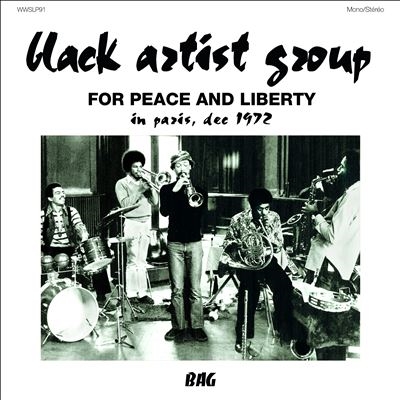
1972年パリで録音された伝説のBlack Artists Groupによる驚異のロング・パフォーマンス
50年ぶりの公式リリースとなるBlack Artists Groupの2ndアルバムが、20ページのブックレットを付属して限定盤LPとしてリリース!
1972年12月にパリMaison de la Radioのラジオ番組Jazz sur Sceneで録音されたオリジナル・テープからリマスタリングされた『For Peace And Liberty』は、フリー・インプロヴィゼーションとスピリチュアル・ジャズをファンク・グルーヴと融合させた35分に及ぶ快演です。
Oliver Lake(サックス), Joseph Bowie(トロンボーン)、 Baikida Carroll(トランペット)、 Bobo Shaw(ドラム)と Floyd LeFlore(トランペット) の子供たちによる言葉とフランスの写真家Philippe Grasによる未公開の写真を含む20ページのブックレットと、Black Artists Groupの有識者Benjamin Lookerによるライナー・ノーツが付属した豪華限定盤。
発売・販売元 提供資料(2024/07/02)
The Black Artists Group (BAG) was a multidisciplinary arts collective from St. Louis, Missouri, between 1968 and 1973, and was a sibling organization to Chicagos Association for the Advancement of Creative Musicians (AACM). Founding member Joseph Bowie was the brother of Art Ensemble of Chicago trumpeter Lester Bowie. BAG offered a seamless convergence of free jazz, global rhythms, and experimental theater.
Their creative umbrella merged explorations of Black and African art and thought with Europes avant-garde. Their organizational goals and public performances drew from and ministered to all artistic and class genres; they sponsored and produced concerts, jam sessions, recitals, exhibits, plays, poetry readings, lectures, and pageants -- on sidewalks, in community buildings (including their own), churches, and classrooms. Among a cast of visual artists, poets, and playwrights, several renowned musicians emerged from BAG including saxophonists Julius Hemphill, Hamiet Bluiett, Oliver Lake, J.D. Parran, and Luther Thomas, trumpeters Baikida Carroll and Floyd LeFlore, trombonist Joseph Bowie, and drummer Charles "Bobo" Shaw.
In 1972, members of BAG left Missouri and the U.S. for Paris, where, Black musicians were welcome and could get solid work. They recorded and self-released a lone album tilted In Paris, Aries 1973, showcasing five original compositions by this quintet -- Bowie, Lake, Shaw, Carroll, and LeFlore. For Peace and Liberty: In Paris Dec. 1972, by contrast, was recorded during a live performance on French radio. This music has remained unheard since that original radio broadcast. The 35-minute gig is divided into six ongoing, freely improvisational sections.
It opens with incantatory percussion from a drum kit, all manner of hand drums and small instruments -- including bells and whistles -- playing Senegalese polyrhythms. That continues in "Part Two" for three-and-a-half of its seven minutes, gathering in intensity until the saxophones bleat in, followed by trumpets and trombone. Here, the band is focused, moving toward the indefinable with ripping brass and reeds as drums get martial and funky. While "Part 3" is quiet, abstract, and in places overly noodly, it offers a foundation for the direct, kinetic style from the ensemble in "Part Four," where everyone plays their parts in rounds and in counterpoint. "Part Five" is the most "inside" section, and resembles something through-composed with strident rhythms, muted trombone, and soaring sax and trumpets. The final section finds the band deep in conversational interplay. Carroll provides a circular vamp for the band to center on, then Lake solos -- flowing through blues, swing, hard bop, and modal sounds. Hes accompanied by Shaw and the log drums. The drummers provide a sense of closure, reprising the Senegalese polyrhythms that opened the set.
Given its source, For Peace and Liberty: In Paris Dec. 1972 is a solid if not a revelatory document. It offers many creative ideas in harmony, rhythm, and modalities that are common today even when its rough, raw, sometimes unfocused, and occasionally lags. These are not drawbacks: BAGs , and were lucky to hear them. ~ Thom Jurek
Rovi