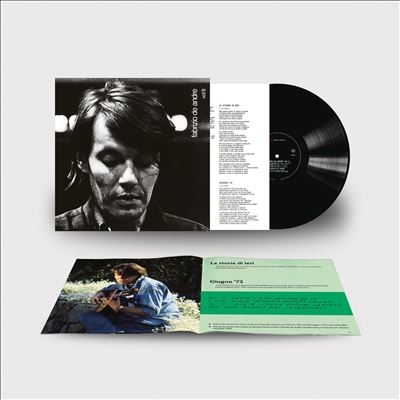
World/Reggae
LPレコード

Volume 8 - Edizione Way Point<限定盤>

0.0

販売価格

¥
9,290
税込
還元ポイント

販売中

お取り寄せ
発送目安
14日~35日

お取り寄せの商品となります

入荷の見込みがないことが確認された場合や、ご注文後40日前後を経過しても入荷がない場合は、取り寄せ手配を終了し、この商品をキャンセルとさせていただきます。

フォーマット LPレコード
発売日 2024年06月下旬
国内/輸入 輸入(ヨーロッパ盤)
レーベルRCA Records Label
構成数 1
パッケージ仕様 180g重量盤
規格品番 19658867561
SKU 196588675614

構成数 : 1枚

  1. 1.[LPレコード]

作品の情報

メイン
アーティスト: Fabrizio De Andre

商品の紹介

Volume 8 is a pivotal album in Fabrizio De Andre's discography. The darkest and most enigmatic record of his career, it is also one of his greatest works -- if not the very best one. By the mid-'70s, De Andre's life had been spiraling down for a while in a mist of alcoholism, depression, divorce, and writer's block. At any rate, he was still discerning enough to perceive greatness in emerging Roman songwriter Francesco De Gregori, and to invite him over for a month or so in the spring of 1973. Together, De Andre and De Gregori wrote most of the material that would eventually make up Volume 8. Although De Andre had been hinting at a new, more elusive direction for his writing (as early as in the 1970s hit single "Il Pescatore," that would not sound out of place here), this is the album that ostensibly -- and defiantly -- confirmed a new frame of reference. If De Andre's first period was born under the sign of 19th century European literature, now he seemed to switch allegiance to Surrealist poetry, filtered through the contemporary eye of songwriters like Bob Dylan and Leonard Cohen. After a decade of story-songs, character-songs, and concept albums, De Andre deliberately discards any narrative concerns, and instead lets his nightmares and wit run rampant. In the process, he finds a new language and imagery that would prove to be as powerful as the fairytale settings of his early songs, but definitely sound more modern. In Volume 8, De Andre no longer sounds like a medieval troubadour magically transplanted into our times, but just like a late 20th century songwriter, and one of avant-garde tendencies, to boot. From the opening track "La Cattiva Strada" onwards, the saga of a mysterious evil character who, for unexplainable reasons, everyone is compelled to follow down his road, is full of ambiguity and moral ambivalence which reign supreme. Very much like Dylan circa 1965-1966, the lyrics are painstakingly long but meandering, full of phrases, wordplay, and images so stunning as to constitute the real focal point of the songs. On the other hand, the ultimate meanings are obscure, if not often nonsensical or whimsical. De Gregori's input is in evidence throughout, particularly in "Oceano," written as a response to De Andre's 12-year-old son Cristiano (who would grow up to be a famous singer on his own), who pestered his dad's colleague about the puzzling imagery of "Alice," one of De Gregori's most famous songs. Indeed, but for De Andre's singing, "Oceano" sounds exactly like an outtake from Alice Non Lo Sa. De Andre also made a point of including "Le Storie de Ieri," a song by De Gregori's whose recording company had initially forbid him to release due to its subject matter about growing up in a fascist state. Besides De Gregori and Dylan, the Leonard Cohen connection can generally be felt in the orchestral arrangements by Tony Mimms, as well as in a sterling Italian version of "Nancy" that arguably surpasses the original. Predictably, De Andre was accused of being unable to write on his own anymore, and of trying to cash in on the success of De Gregori's breakthrough album Rimmel released the same year. Still, the two darkest, best, and most emblematic songs of this album are the only two De Andre wrote alone, "Giugno '73" and "Amico Fragile." De Andre himself considered the latter the most important song he ever wrote and his most personal, one, that spoke for none but himself. An extended inner monologue, half nightmare, half drunken stupor, delivered against a relentless string tremolo in the manner of Cohen's "Avalanche," "Amico Fragile" includes snippets of deadpan misanthropy such as: "Did you know I have lost two sons?," "Madam, you must be a rather absent-minded woman." It is certainly the most fully realized statement of De Andre's disgust at all the cliches, falsities, and banalities of the so-called polite society. "Giugno '73" shares many of those themes, but the tone is different since it is a to be continued...
Rovi

メンバーズレビュー

レビューを書いてみませんか?

読み込み中にエラーが発生しました。

画面をリロードして、再読み込みしてください。