Mojo - 4 stars out of 5 - "[A] delicate and gorgeous deconstruction of Pachelbel's Canon..."
Mojo (p.127) - 4 stars out of 5 - "[A] delicate and gorgeous deconstruction of Pachelbel's Canon..."
Uncut - "DISCREET MUSIC stays closest to his original concept of a subtle music designed to alter the listener's environment."
Rovi
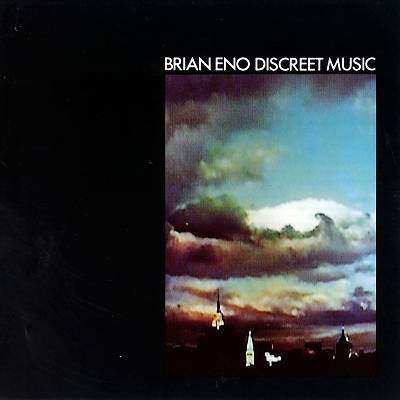
DISCREET MUSIC is Brian Eno's first break with pop music in favour of a quieter, more meditative form, and it came about by accident. When Eno was confined to bed after an auto accident, a visitor brought him an album of classical music, which he mistakenly put on the stereo at a very low volume. Unable to get up to raise the volume, Eno heard the quiet music blend with the natural sounds of his environment, and conceived a music designed for that purpose. The several lengthy pieces on DISCREET MUSIC are named after quotes from the liner notes of a recording of Pachebel's Canon in D, which also provides the structure of the pieces themselves. Built on subtle tape loops, the pieces retain just enough of those structures to avoid the deliberate formlessness of Eno's later ambient experiments. The very beginnings of ambient music are on this disc.|
Rovi
The latter part of 1975 was a remarkably creative period for Brian Eno. With his masterpiece Another Green World, Eno began moving away from the structure and sound of pop music toward a more static instrumental model, influenced in part by Erik Satie and strongly informed by his prior collaborations with Robert Fripp. Recorded just a month after Another Green World, Discreet Music is his first full foray into what has become known as ambient music. Using the same system of two reel-to-reel tape recorders as No Pussyfooting and Evening Star, Eno was able to layer simple parts atop one another, resulting in a beautiful piece of music that never really changes but constantly evolves with the addition and decay of different parts. And while there were elements of noise and dissonance on the albums with Fripp, all the sounds here are calming and serene. The second half of the album deals with the same ideas of recurring themes and evolution but uses a different approach. Here, members of the Cockpit Ensemble use pieces of the score of Pachelbel's Canon in D Major, but the relation of these elements changes over time by having the parts slow at differing intervals or using different lengths of the musical score. The same notions of theme and constant variation appear, but without the aid of the tape delay system. The tones of the strings are vastly different from the synth tones of the title track, but the effect on the listener is the same, with the pieces delicately unfolding over time. Discreet Music's reputation as a groundbreaking and influential work is surpassed only by its placid beauty. Highly recommended.
Rovi
The latter part of 1975 was a remarkably creative period for Brian Eno. With his masterpiece Another Green World, Eno began moving away from the structure and sound of pop music toward a more static instrumental model, influenced in part by Erik Satie and strongly informed by his prior collaborations with Robert Fripp. Recorded just a month after Another Green World, Discreet Music is his first full foray into what has become known as ambient music. Using the same system of two reel-to-reel tape recorders as No Pussyfooting and Evening Star, Eno was able to layer simple parts atop one another, resulting in a beautiful piece of music that never really changes but constantly evolves with the addition and decay of different parts. And while there were elements of noise and dissonance on the albums with Fripp, all the sounds here are calming and serene. The second half of the album deals with the same ideas of recurring themes and evolution but uses a different approach. Here, members of the Cockpit Ensemble use pieces of the score of Pachelbel's Canon in D Major, but the relation of these elements changes over time by having the parts slow at differing intervals or using different lengths of the musical score. The same notions of theme and constant variation appear, but without the aid of the tape delay system. The tones of the strings are vastly different from the synth tones of the title track, but the effect on the listener is the same, with the pieces delicately unfolding over time. Discreet Music's reputation as a groundbreaking and influential work is surpassed only by its placid beauty. Highly recommended. ~ Sean Westergaard
Rovi