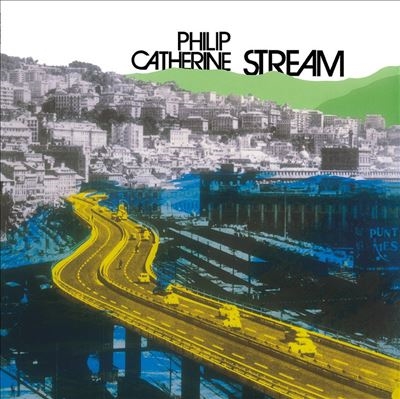
By the time guitarist Philip Catherine released his solo debut Stream in 1972, hed been a professional musician for more than 12 years. Hed played on a handful recordings of astonishing variety including Jack Sels The Sexy Sax of Sels & Swinging Friends in 1963 and the Lou Bennett Trios Hammond Organ single in 1967. He also wrapped up a stint with Jean Luc Ponty. Stream was cut in 1970, but held up due to contractual touring with Ponty. In a dozen short tunes (none over four minutes), Catherine melds the modern influence of guitarists such as Larry Coryell and John McLaughlin with his formal training, which included the techniques of Django Reinhardt, Jim Hall, and Barney Kessel. Stream was produced by Sasha Distel; its the guitarists first recorded collaboration with the mighty pianist and jazz-funk innovator Marc Moulin, with whom he would work periodically until the pianists death. The lineup also includes trombonist Jiggs Whigham, drummer Freddy Rothier, and bassist/flutist Freddie Deronde. Moulin penned five tunes, Catherine four more and one with Deronde, and two covers. Opener Memphis Talk is a slippery, snare-heavy blues that makes its transition to funky jazz within its first turnaround. Catherines solo is blazing, it careens through multiple styles. Whighams trombone joins with the guitarists melody in Moulins November. Its jazz harmonics balance a midtempo, serpentine ballad, funky jazz, and prog rock. Catherines early jazz-rock fusion leanings are revealed abundantly on Un Ecossais Dans Une Chambre Noir, with its twinned lead lines (overdubbed) fueled by Rothiers punchy breaks. Modern jazz gets its first nod in C. Et D, with its edgy Rhodes piano also trailing along after sci-fi soundtracks, Catherines playing centers its progressions along syncopated lines. Bass Line is a fusion classic with Catherine trading sharp, silvery arpeggios with Moulins edgy chord voicings and powerhouse rock rhythms. The influence of Frank Zappas Peaches en Regalia is readily apparent on the knotty, majestic Cloitre Des Celestins, with Whigham joining the front line. In under three minutes, Stream pays homage to McLaughlins vampy playing with Miles Davis, the Eleventh Houses tripped-out effects, and Zappas love of classical jazz fusion. An unaccompanied read of Narciso Yepes film theme Joyeux Interdits is a glorious solo showcase for Catherines improvising. Charles Bobbitts Give It Up and Turn It a Loose (sic), is rendered with a fat, whomping groove, complete with wah-wah trombone and a greasy flute break. The set closes on the jazz tip with Moulins easy-grooving, summery Lets Put It Like This. While Stream is rawer and less focused than 1974s classic September Man, it arguably dates better due to its groove-laden core; further, it reveals Catherine as one of the great ensemble players of his generation. This is the showcase for his solo prowess. [The 2020 Japanese KTI reissue includes three bonus tracks penned by the guitarist and Deronde: an extended Bass Line, the uber funky Enfin Brief, and the fusion of Next Time.] ~ Thom Jurek
Rovi
ダッチ・プログレバンド最高峰フォーカスへ参加する一方でステファン・グラッペリからチェット・ベイカー、ラリー・コリエルまで豪華共演経歴を誇る、ベルギー人ジャズギタリスト、フィリップ・カテリーン。マーク・ムーラン率いるジャズ・ロックバンド、プラシーボへも参加した彼がそのマーク・ムーランとプラシーボのメンバー参加のもと1972年に発表した初ソロ作が初CD化。クール&メロウなファンクからプログレッシヴな泣きのキメ、ブルージーなリフや、ファジーな《禁じられた遊び》まで、このヴァラエティとグルーヴが最初から最後まで飽きさせない。ブリージンなJBカヴァーも最高!
intoxicate (C)片切真吾
タワーレコード(vol.130(2017年9月25日発行号)掲載)