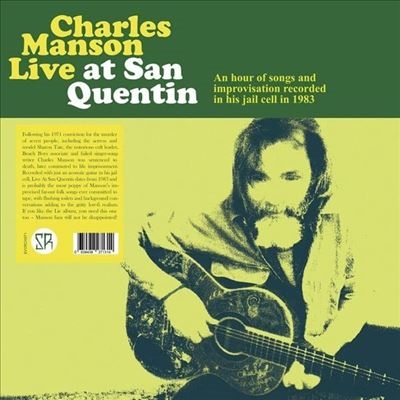
悪名高いカルト宗教家犯罪者かつカルト・インセイン・シンガー・ソングライター、グルの中のグルCHARLES MANSON。ビーチ・ボーイズ『ペット・サウンズ』 を流用したジャケも素敵な、1983年マンソン刑務所ライヴ・アルバムが再発!
トイレの音や背後での会話がローファイで硬質なリアリズムを醸し出しています。
発売・販売元 提供資料(2022/12/21)
Unlike B.B. King's Live in Cook County Jail or Johnny Cash's At Folsom Prison, Charles Manson's Live at San Quentin is not a fully produced concert performance album. Taped on a portable cassette deck right there in the lockup in 1983, it exists as a twisted footnote to his 1967 studio recording. Instead of extras like sitar, percussion, and chanting Manson girls, you get authentic Quentin cell block ambience, complete with droning television, flushing toilets, and the voices of other inmates. The 13 segments marked in this nearly 57-minute stream-of-consciousness medley are punctuated with emotionally torqued guttural outbursts and gritty profanity. Manson, a native of Cincinnati, grew up in multiple juvenile detention centers, reformatories, and jails. He has spent most of his adult life in prisons and penitentiaries. His longest period of freedom took place in California, where he developed a persuasive persona that enabled him to gradually build a following composed mainly of young, impressionable runaways, some of whom were coerced into committing shockingly homicidal acts. When his "assassins" crossed over from butchering regular citizens to killing rich people and movie stars, Manson found himself permanently suspended in the aspic of Andy Warhol's most overrated concept -- Fame. By the time this recording was made, he had been back behind bars for about 14 years, and both mind and voice were showing the effects of prolonged incarceration. His improvisatory ramblings contain references to old-time country music ("My Name is Sam McGee," "Boxcar Willy and Big Bad Joe"), the inescapable cell block TV ("Television Mind"), and mainstream U.S. pop culture ("Marilyn Monroe Was My Childhood Shame"), but most of the time Charlie dishes out whatever pops into his head, and that could be just about anything. During "So as the Hour Goes on That I Will Spend with You," he bends down and addresses the tape deck, first as "Sunny," then "Sony." On "I Got a Tough Bastard Child Want to Become into a Samurai" he picks up the tempo and actually engages in a bit of scat singing. Six minutes into "Take Me to the Summer Road," Manson suffers a coughing fit and theatrically incorporates it into the act, adding groans, grunts, and growls, carrying on wordlessly, finding a sort of "Om" tone, and ultimately digressing into a growling scat passage that is truly arresting. The final track ("And So the Mood Was Broken") consists almost entirely of mutterings and softly spoken expostulations interspersed with periodic toilet flushes. While this is a far cry from the Lomax recordings of Huddie Ledbetter while he was an inmate of the Louisiana State Penitentiary at Angola in 1934, the authenticity of Charles Manson Live at San Quentin places it with other historic prison recordings, even as it occupies a micro-genre all its own. ~ arwulf arwulf
Rovi