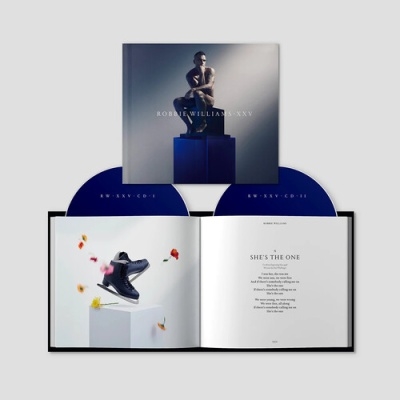
To celebrate 25 years as one of Englands biggest superstars, global pop icon Robbie Williams teamed with the Metropole Orchestra to reimagine past hits and craft fresh originals on his 13th full-length, XXV. Under the guidance of chief conductor Jules Buckley, the Dutch orchestra -- whose past crossover collaborations include everyone from Basement Jaxx and Tori Amos to Ella Fitzgerald and Brian Eno -- adds the required heft and grandeur to the album, allowing Williams vocals to truly shine without the distraction of overly produced mainstream pop tendencies. Kicking off, of course, with a suitably lively take on the master showmans "Let Me Entertain You," XXV spoils listeners with nearly two dozen selections (close to 30 on the deluxe edition), plucking from almost every era (sorry, Rudebox) but sticking mainly with the prime period from 1997s debut Life Thru a Lens to 2005s Intensive Care. The sweeping "Eternity" and "Come Undone" swell atop steadily building strings and a warm chorus, while standouts like the groovy "No Regrets and the horn-washed "Millennium" channel the grandiose cinematic scale of the James Bond themes. The fun-loving "Rock DJ" retains its original party-starting energy, pumped up with lively backing vocals and peppy horns, while his Kylie Minogue collaboration "Kids" manages to become even more raucous with the added layers of instrumentation. His trademark, singalong showstopper "Angels" is as majestic as ever, its heavenly inspiration sent higher into the stratosphere with a shiver-inducing horn section and choir embellishment. In similar fashion, "Bodies" and "Feel" push the emotional urgency to a breaking point, offering another pair of highlights. Of the newly recorded songs, "Lost" is a nostalgic, midtempo cut that could have been one of his biggest hits from his turn-of-the-millennium peak, sparkling with tinkling keys, a bold wave of strings and twangy guitar, and some of Williams most gorgeous singing on the album. The reworkings dont always hit the mark: "Tripping"s ineffable oddball urgency is subdued without the original production, no matter how pretty the result, and the "Copacabana"-ness of the updated "Candy" somehow becomes cornier without the intentionally throwback tone of the original. Still, these tiny nitpicks are only relative to the rest of the collection; overall this is a stunning take on a greatest-hits package that will please at every turn. Longtime fans should enjoy these luxurious reimaginings, which tastefully mature Williams sound as much as the erstwhile bad boy himself. ~ Neil Z. Yeung
Rovi