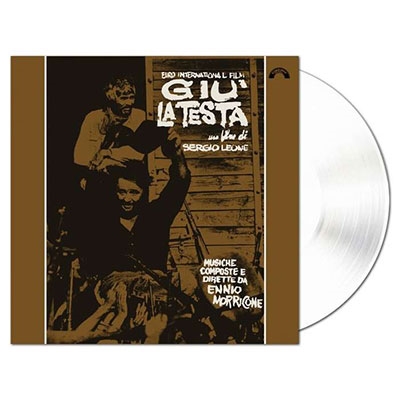
With classic films like The Good, the Bad and the Ugly and Once Upon a Time in the West, Sergio Leone built his reputation as a master of the Western. A key part of these film's unique style was their soundtracks, all of which were crafted by Ennio Morricone: his singular mixture of avant-garde quirks, pop instrumentation, and traditional orchestral romanticism played a crucial role in helping Leone redefine what audiences expected from a Western. Giu la Testa is the soundtrack to Leone's last foray into the genre, and as a result there is a certain bittersweet romanticism that infuses the typical quirks present in a Morricone score: the title track may have a cut-up structure and some bizarre choral vocals, but the true heart of the composition is an emotionally searing wordless solo from Edda Dell'Orso that communicates heartache far better than any lyrics ever could. The sweetly crafted heartache of that moment is further elaborated on in cues like "Mesa Verde," which uses a gentle bed of strings to cushion a fragile, sad melody built on stately horns and some Spanish-flavored acoustic guitar, and "Dopo L'Esplosione," a quietly tragic tune that layers a heart-tugging, whistled melody with subtle orchestration. However, the album isn't all somber melodicism: Giu la Testa's sense of melancholy is balanced by some playful moments like "Scherzi a Parte," a jaunty reworking of elements from the main theme that contrasts a carefree whistled melody with odd electric keyboard riffs, and "Marcia Degla Accattoni," a clever cue that tarts up its march-styled orchestral melody with quirks galore (singers croaking nonsense syllables, unexpected mandolin parts, unexpected whistle, and harpsichord breaks). The remainder of the cues mostly revisit melodic elements from the main theme, but none ever wear out their welcome thanks to Morricone's relentlessly innovative touch as an arranger. All in all, Giu la Testa represents one of the towering achievements in Ennio Morricone's catalog, because it represents the one-of-a-kind blend of romanticism and musical innovation that defines his finest work in the Western soundtrack genre.
Rovi
With classic films like The Good, the Bad and the Ugly and Once Upon a Time in the West, Sergio Leone built his reputation as a master of the Western. A key part of these film's unique style was their soundtracks, all of which were crafted by Ennio Morricone: his singular mixture of avant-garde quirks, pop instrumentation, and traditional orchestral romanticism played a crucial role in helping Leone redefine what audiences expected from a Western. Giu la Testa is the soundtrack to Leone's last foray into the genre, and as a result there is a certain bittersweet romanticism that infuses the typical quirks present in a Morricone score: the title track may have a cut-up structure and some bizarre choral vocals, but the true heart of the composition is an emotionally searing wordless solo from Edda Dell'Orso that communicates heartache far better than any lyrics ever could. The sweetly crafted heartache of that moment is further elaborated on in cues like "Mesa Verde," which uses a gentle bed of strings to cushion a fragile, sad melody built on stately horns and some Spanish-flavored acoustic guitar, and "Dopo L'Esplosione," a quietly tragic tune that layers a heart-tugging, whistled melody with subtle orchestration. However, the album isn't all somber melodicism: Giu la Testa's sense of melancholy is balanced by some playful moments like "Scherzi a Parte," a jaunty reworking of elements from the main theme that contrasts a carefree whistled melody with odd electric keyboard riffs, and "Marcia Degla Accattoni," a clever cue that tarts up its march-styled orchestral melody with quirks galore (singers croaking nonsense syllables, unexpected mandolin parts, unexpected whistle, and harpsichord breaks). The remainder of the cues mostly revisit melodic elements from the main theme, but none ever wear out their welcome thanks to Morricone's relentlessly innovative touch as an arranger. All in all, Giu la Testa represents one of the towering achievements in Ennio Morricone's catalog, because it represents the one-of-a-kind blend of romanticism and musical innovation that defines his finest work in the Western soundtrack genre. ~ Donald A. Guarisco
Rovi
ついに出た、噂の2枚組!! 秘蔵トラック満載!!
『夕陽のギャングたち』(1971)
35周年記念盤2枚組
音楽 エンニオ・モリコーネ
監督 セルジオ・レオーネ
主演 ロッド・スタイガー、ジェームズ・コバーン
哀愁のマカロニ・ウエスタンの香り高い傑作中の傑作
のサントラが、オルタネイト・トラック(別トラックや、
フィルム・バージョンなど)満載で、ファンに贈る2枚組
でリリース!! いずれも、美しく男の哀愁漂うナンバー
ですが、テーマだけでも、他の5バージョンが聴ける!!
マカロニ・サントラなのに、うっとりと聞き惚れる、という
形容がぴったりな職人芸中の職人芸を堪能しまくり。
全音楽ファンにおすすめの大傑作の特別盤!!
(渋谷店4Fサントラ・コーナー内に膨大なエンニオ・モリコーネ・コーナーございますので、そちらもご利用ください)
(C)馬場敏裕
タワーレコード(2006/11/04)
『夕陽のギャングたち』(1971)のサウンドトラック。音楽 エンニオ・モリコーネ、監督 セルジオ・レオーネ、主演 ジェームズ・コバーン、ロッド・スタイガー。モリコーネの音楽史上の中でも、10本の中には入る代表作。なんといっても、エッダ・デル・オルソならではのヴォカリーズが美しいテーマを含め、マカロニ・サントラというよりも、全くもって「美しいモリコーネ節」が全開。ファンは必携の一枚。
(C)馬場敏裕
タワーレコード(2003/12/01)