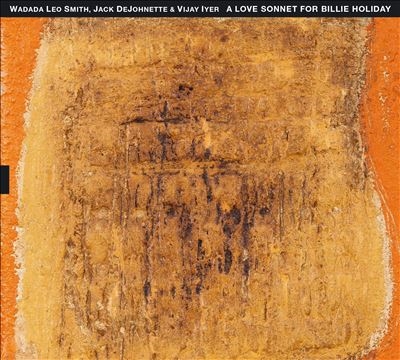
Few artists get the kind of second act renaissance Wadada Leo Smith has enjoyed. It began during the mid-90s when he issued scores of recordings for labels such as ECM, New World, Tzadik, and Cuneiform. Finlands TUM Records is celebrating the composer/trumpeters 80th year with six new releases. The single-disc A Love Sonnet for Billie Holiday is a trio session simultaneously released with the box set, The Chicago Symphonies, by the trumpeters Great Lakes Quartet. His collaborators here are longtime associates. Smith and drummer/percussionist Jack DeJohnette have worked together periodically since the 60s. The drummer played in his original Golden Quartet and is a member of the Great Lakes Quartet. Pianist/organist/electronicist Vijay Iyer appeared on Tabligh, Golden Quartets third album (without DeJohnette) in 2008. They have never worked as a trio before. Smith writes in the booklets notes that that the musical template for this group lie in his early partnership with Anthony Braxton and Leroy Jenkins on his composition "The Bell," from the saxophonists 1969 debut album, Three Compositions of New Jazz. It illustrated the concept of the trumpeters "rhythm units" in balancing sounds, textures, and silences without regard for swing. Smith wrote two pieces here, his collaborators one each, and the final work is a group improvisation.
On the opening title cut, Smith reflects his notion of the vocal influence of his tribute subject. DeJohnettes cymbals and tom-toms introduce its motion in implied but elastic time signatures. Smith enters with a majestic yet moaning bleat at four minutes. Iyer whispers in on the piano before offering contrapuntal block chords as the drummer bridges the conversation with his own articulate utterances. The sparseness and elegant textures are nearly song-like in places, yet the dynamics eventually extend the tunes reach toward the limits of sound itself. Iyers "Deep Time, No. 1” showcases his Fender Rhodes hovering across Smiths bell-like horn, DeJohnettes mallets, and electronically sampled vocals. The track is a series of clipped statements linked to one another by space, reverbed piano, and disembodied voices before muted trumpet notes express resonant emotion. Making a return appearance is DeJohnettes oft-recorded "Song for World Forgiveness," delivered here as an amorphous, reverential, seemingly out-of-time ballad, balancing hope and sorrow. Closer "Rocket" is introduced by Iyers roiling, pulsing, and rumbling B-3 atop DeJohnettes syncopated shuffle, feints, and accents as Smiths muscular trumpet initially addresses then responds to his bandmates choogling groove with dark, punchy vamp-like lines. As it unfolds, each musician asks sonorous questions of the others. Rather than answer directly, each player underscores with curiosity the nebulous spirit inside their exchange to push at the boundaries of tonality, time, and texture. On A Love Sonnet for Billie Holiday these players offer intimacy, economy, and graceful restraint. While tensions rise with sustained insistence across the tunes, the trios deeply communicative exchanges push the music -- and one another -- ever forward without concern for final resolution; it leaves their dialogue sufficiently open for interpretation. ~ Thom Jurek
Rovi