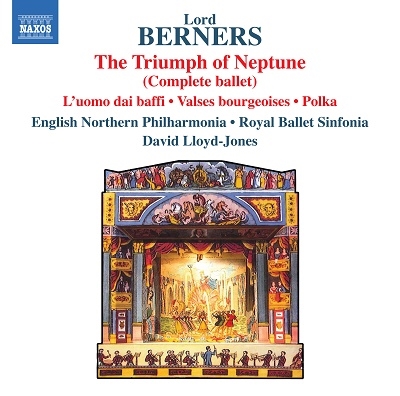
イギリスの作曲家・小説家・画家、ロード・バーナーズ(バーナーズ卿)。本名はジェラルド・ヒュー・ティアウイット=ウィルソンという名門バーナーズ家の第14代男爵です。イートン・カレッジで学び爵位を継承するまでは外交官として活躍、音楽家としても才能を発揮し、このアルバムに収録されている『ネプチューンの勝利』はディアギレフのバレエ団のために書かれバランシンが振付を施したもの。野心的な音楽をストラヴィンスキーが称賛したという彼の代表作の一つです。『口ひげを生やした男』はイタリアの人形劇団Balli Plastici社から依頼されたバレエ音楽。この組曲にはカゼッラやマリピエロも新作を寄せ、他にはバルトークの既存のピアノ曲もアレンジして部分的に用いられています。他にはフィリップ・レーンの巧みなオーケストラ・アレンジによる「ブルジョア風のワルツ」と「ポルカ」を収録。センスのよい洒落た音楽を楽しめます。
ナクソス・ジャパン
発売・販売元 提供資料(2021/07/05)
Lord Berners is, understandably, the short form of the honorific attending to English baron the Right Honorable Sir Gerald Hugh Tyrwhitt-Wilson. Berners was most things a man of peerage should not be -- he was unambitious, uninterested in the diplomatic corps for which his rearing prepared him, and "worst" of all, a musician. Marco Polo's Lord Berners: The Triumph of Neptune features conductor David Lloyd-Jones in a program of ballet, theater, and film music of Lord Berners in works stretching from his early "futurist" period of 1918 to a more germane, but still sharply hewn, stylistic idiom dating from the Second World War.
The most fascinating work here is L'uomo dai baffi (1918; The Man with the Moustache), incidental music composed for a marionette theater performance organized by Italian futurist Fortunato Depero. Berners' score, made for a tart-sounding chamber orchestral combination, is occasionally reminiscent of Stravinsky, though other parts are reminiscent of music that Luigi Dallapiccola would be writing 30 years hence. One could argue that Berners was writing Italian futurist music that Italian futurist composers, such as Balila Pratella, should have been writing owing to their own aesthetic precepts, but didn't. Berners' compositional style had managed to shed most of its biliousness by the time of the ballet The Triumph of Neptune in 1926, but his music retained plenty of its salt. This, and his penchant for near-cinematic turns of phrase, prevents The Triumph of Neptune from being purely neo-classical. The ballet contains its moments of lyricism, as well, particularly in the cue "Cloudland." The storyline for The Triumph of Neptune is wonderfully nonsensical in manner of Cocteau's libretto for Satie's Parade; numbered among the original dancers in the premiere were Alexandra Danilova, Serge Lifar, and George Balanchine. It must have been a handsome production, indeed, and if you close your eyes as you listen to this music you can almost see it. Marco Polo's excellently well-engineered recording and Lloyd-Jones' disciplined, clearly articulated reading make the visual effect all too clear.
The Valses bourgeoises (1919) are also early, but are parodies of pre-existing pieces; for example the third waltz is titled "Strauss, Strauss et Straus." Polka (1941), although composed independently, was ultimately used in the Ealing film Champagne Charlie (1944); it sounds like a polka jointly composed by Bernard Herrmann and Danny Elfman. Despite that, Lord Berners had only limited direct contact with film, and that limited to a part of his life ultimately claimed by advanced depression; his non-futuristic music is visual in feel. Marco Polo's Lord Berners: The Triumph of Neptune has a great deal more of a general audience appeal than this modest disc, and the continued obscurity of Berners himself, would suggest at first glance. Even though it's not film music, if you love film music most likely you will love most of this; likewise, if the music of William Walton or Constant Lambert appeals to your ears, then Marco Polo's Lord Berners: The Triumph of Neptune will not be far off those marks.
Rovi