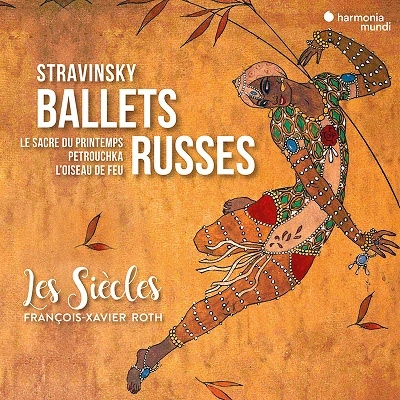
世界中に衝撃を与えたロト&レ・シエクルの「バレエ・リュス」2枚組で登場!!
CDリリースのたびに世界中に大きな音楽的ショックを与え続けているロト&レ・シエクル。2014年度レコード・アカデミー大賞を受賞した衝撃の名盤「春の祭典」&「ペトルーシュカ」[ASM-015およびKKC-5401、いずれも廃盤]、そして「火の鳥」が入ったアルバム[ASM-06およびKKC-5195、いずれも廃盤]が、このたびharmoniamundiレーベルからあらたな装いで2枚組として再登場します!
「春の祭典」は1913年5月29日、モントゥーの指揮によりシャンゼリゼ劇場で初演され、音楽史上最大のスキャンダルとなりました。今日では人気曲として、またオーケストラの性能を披露できる好個の楽曲として頻繁に演奏されますが、複雑な変拍子、無理な楽器法など、古楽器あるいは古楽指揮者には不可能な作品とされてきました。ここでは、まず冒頭のファゴット(1900年ビュッフェ・クランポン製バソン)の音から未知のもので衝撃度満点。また小型のフレンチ・チューバ、小トロンボーンも新鮮で、ピストン・ホルン8本の響きも独特。ロシア的な重量感あふれる音で奏されるのが常ですが、この明るいフランス的音色こそまさに初演時の音。目から鱗が落ちる衝撃度です。
また「春の祭典」初演時1913年版楽譜は自筆のままでパウル・ザッハー財団が所蔵していますが、ロトはこれと1922年ロシア音楽出版社初版のスコア、モントゥー所蔵の1920年代初頭の楽譜を検討、音の間違いとストラヴィンスキーが改訂した箇所をはっきりさせ、1913年5月29日初演時の音の再現を試みました。
「ペトルーシュカ」も初演時1911年版。四管の大編成で、協奏曲風に活躍するはずのピアノがあまり目立ちません。ここでは日本人ジャン=ヒサノリ・スギタニが1892年製エラールのピアノで美しい響きを醸し出しています。通常の交響楽団がこの版をとりあげると、もっさりと重くなりますが、ロト&レ・シエクルは大編成なことを意識させない透明さ。ことにグロッケンシュピールやチェレスタのキラキラした響きが効果的で、ロシア・バレエならではの夢のあふれる世界を創り出しています。
「火の鳥」全曲でも、この作品が百年前の1910年6月、ピエルネの指揮によりパリ・オペラ座で初演された際の響きを再現しています。ピッチこそさほど違和感はありませんが、弦楽器はガット弦、金管は細管、木管やハープはいずれもフランス製で、パリ音楽院直伝の奏法を遵守しているため、聴感上の印象はかなり違います。ヴィブラートも少なめで、パステル画のような色彩がいかにもフランス風。4管の大編成ながらすっきりしていて、金管の響きが独特。原色的で厚い音というストラヴィンスキーのイメージが一新され新鮮の極み。グラズノフのサウンドも向いていて、作品の爽やかさに痺れさせられます。
ブックレットに弦楽器以外すべての使用楽器が明記されていて、貴重な資料となっています。
キングインターナショナル
発売・販売元 提供資料(2021/05/25)
The music on this double album, encompassing Stravinskys three famous pre-World War I ballets plus assorted other works, was taken from live performances by the historically oriented orchestra Les Siecles and its conductor Francois-Xavier Roth between 2010 and 2013. Most have been issued previously, but there are good reasons to check out the whole set. One is that the documentation is more thorough here, with an interview-style reflection from Roth on the investigations of what Stravinskys music might have sounded like in Paris in 1913. Another is that putting all of this music together reveals connections between Stravinsky and the more conservative Russian composers whose music held the stage in Paris around the same time. The Rite of Springs style was not invented out of whole cloth but relied, to a degree and in interesting ways, on the music, by various composers, in a ballet called Les orientales. Further, the score of The Rite of Spring used here is an original version with some differences from what is usually heard. What needs to be said is that however one chooses to access this music, its well worth hearing. Roth and company restrict their palette to instruments that would have been available in Paris in the early 1910s, and the sound has a delightful warmth and transparency that seems to inflect Stravinskys three ballets in new ways. The low gut strings add a nocturnal flavor to the scenes of the Rite, and in general, the textures, with the lighter wind and brass sounds, are unusually transparent. Roths reading of The Rite of Spring is not of the bacchanalian type, and some may find it, as often with historical-instrument readings at first, a bit underpowered, but it has its impact without the pounding rhythms. As when encountering other music generally performed by modern ensembles, approach with an open mind.
Rovi