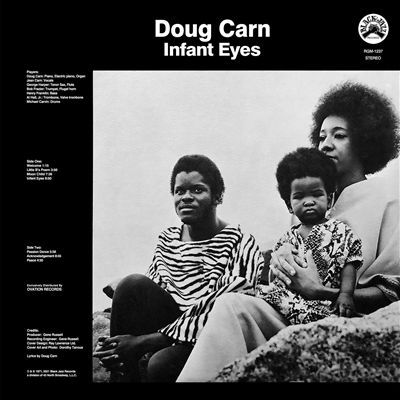
Though composer and multi-instrumentalist Doug Carn cut a hip organ trio record for Savoy in 1969, its 1971s Infant Eyes, his Black Jazz debut with vocalist and then-wife Jean Carn, that endures as a spiritual soul-jazz classic and arguably created the genre. Though the Carn composition here is Moon Child, he penned killer lyrics for Jean inside compositions by John Coltrane, Bobby Hutcherson, Wayne Shorter, and Horace Silver. Further, his complex harmonic charts made his sextet sound like an orchestra, establishing him as an arranger. This set also marked the recording debuts of drummer Michael Carvin and bassist Henry Franklin (who would issue The Skipper for Black Jazz the following year). Other players included veteran saxophonist/flutist George Harper, trombonist Al Hall, Jr., and trumpeter Bob Frazier.
The album opens with a brief read of John Coltranes Welcome as brass, reeds, winds, modal and Rhodes piano, bass, and drums all enter on a crescendo before Jean wordlessly soars above them. Hutchersons Little Bs Poem commences as a swinging, soul-jazz groover, led by Carns whimsical Hammond organ and swinging hard bop drums. Jean nearly scats the lyric before the horns surround her in a waterfall of cadences, underscoring her souled-out delivery. Shorters title cut is a long spectral ballad. Electric piano and cymbals whisper in the vamp before Jean deliberately and artfully articulates the melody through Carns life-affirming lyrics; the band hovers and floats like a jazz chamber group behind her, providing her freedom to improvise. Carns Moon Child offers humor as the piano playfully apes Traffics vamp to Low Spark of High Heeled Boys in the intro) before the horns enter in procession. Franklin walks them along the gradually unfolding modal groove while Carvin fills and rolls around them all. Harpers tenor break channels Coltrane, Shorter, and Sonny Rollins. McCoy Tyners Passion Dance (from 1967s The Real McCoy) is rendered ingeniously; Carn employs the B-3 to wed driving hard bop to soul-jazz. Franklins furious bassline, Harpers roiling sax, and Carvins skittering, break-laden kit work push Carn toward modal exploration with expansive chord voicings punctuated by speedy single-note runs. Carn never sacrifices the swinging, songlike structure while underscording the complexity in Tyners harmonic inquiry. The Acknowledgement section of Coltranes A Love Supreme is rendered with elegance and spiritual soul in Jeans delivery. The familiar bass and piano theme buoys her. The horns gather force and cascade under and around her as Carn lays down fat, open-ended chords for the rhythm section to play off. His lyrics are full of optimism and spirituality. Horace Silvers Peace closes. Carns chart showcases an elegant interplay between bass and Rhodes piano as Jean expresses the lyric with nuanced resolve and resonance while the trombone emerges as a second voice. All of Carns Black Jazz titles are influential, but Infant Eyes arrived at a special cultural juncture. It balanced accessibility with adventure and established both the label and the Carns as co-creators of a brand new, specifically Afro-centric approach to creative jazz. ~ Thom Jurek
Rovi