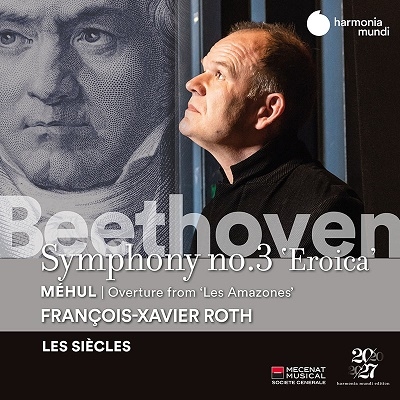
期待を上回る鮮烈な演奏!
ロト&シエクルのエロイカついに登場!!
鮮烈な「運命」で度肝を抜いたロトとシエクルのベートーヴェン、次なる挑戦は交響曲第3番「英雄」ですが、前作を上回る快演に圧倒されまくり。
ベートーヴェンの交響曲第3番「英雄」は50分に及ぶ長さ、指揮者なしでは演奏し得ない複雑さ、政治性を公然と示す内容など、作曲された1804年当時には類のない革新的なものでした。さらに激流か溶岩のような止めることのできぬ音楽の迸りなど、ロマン派様式の明らかな萌芽もみられます。
ロトは前作「運命」と同様にベートーヴェン作品の革命的側面に焦点を当て、さらに同時代のフランス作品をカップリングして多くの示唆を与えてくれます。今回はメユールの歌劇「アマゾネス」序曲。メユールはベートーヴェンより7歳年長で、ナポレオン時代のフランスを代表するオペラ作曲家。考えられている以上にベートーヴェンと共通点が多く、オーケストラの職人でした。メユールの交響曲第1番とベートーヴェンの第5番の類似性はシューマンも指摘しています。
ピッチは430Hz。現存するベートーヴェン時代の管楽器はもはや演奏不能なため、レプリカを使用。ロトは世界中のオーケストラと「英雄」を演奏してきましたが、フィナーレのコーダもしくは最後の変奏はモダン楽器だと活力に欠け鈍重になってしまうとしています、しかしピリオド楽器ならアクセントのインパクトを強調でき、現代楽器だとすべて同じような色彩になるベートーヴェンの調性選択も、変ホ長調の意図がよくわかるとのこと。
各楽章の演奏時間は、1:15'58"、2:14'28"、3:5'29"、4:10'58"で、特に変わったものではないものの、透明な音色、はつらつとして推進力に満ちているため実際よりも速く聴こえます。そのリズム感の良さと引き締まった造形、みなぎる緊張感いずれも見事。さすがロト、これほど新鮮な「英雄」は初めて聴くようです。
キングインターナショナル
発売・販売元 提供資料(2021/03/18)
The Harmonia Mundi labels Beethoven symphony cycle in observance of Beethovens 250th birth-year anniversary has switched horses in midstream, from the Freiburger Barockorchester to Les Siecles under conductor Francois Xavier-Roth, and this is not a bad thing. The application of historical-performance principles to Beethoven is growing, and the two ensembles bring different perspectives on the effort. This recording of the Symphony No. 3 in E flat major, Op. 55 (Eroica) brings plenty of fresh ideas. Overall, it is perhaps a historical-performance reading for listeners less enamored of such things; the period (or period copy) brass and winds have a carefully controlled, smooth sound, and Xavier-Roth keeps them mixed into the texture, nicely balanced against the large group of low strings. Those looking for the shock value of blaring trumpets wont find them here, but Xavier-Roths approach is equally valid. There are several other unusual details. For the solo-strings second variation in the finale, Xavier-Roth can point to musicological research. Its less clear that he can do so for the orchestrally rolled chords at the beginning and elsewhere; these rob the opening of its clarion-call quality. Nevertheless, this is a well-integrated historical-instrument performance of Beethoven, and its enhanced by the inclusion of the overture to Mehuls opera Les Amazones to ring down the curtain. The booklet gives conflicting information as to the degree of Mehuls influence on Beethoven (he did own at least one Mehul score), and this work, in any event, is from 1811, but the French revolutionary strand in Beethovens music is well known, and the overture fits satisfyingly here. Kudos to Harmonia Mundis engineers for smooth mastering of music recorded in three different venues.
Rovi