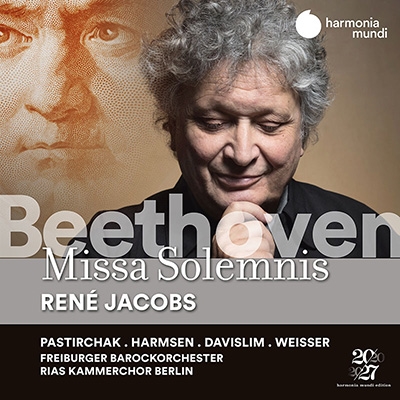
ヤーコプスによる「ミサ・ソレムニス」が登場!
ハルモニアムンディのベートーヴェン生誕250周年である2020年から没後200年となる2027年に向けた録音企画シリーズ。2021年初回のリリースはヤーコプス指揮による「ミサ・ソレムニス」。
ベートーヴェンの「ミサ・ソレムニス」は、作曲家最晩年の大作であると同時に、解釈が非常に難しいことでも知られますが、それだけに指揮者の力量が問われます。
ベートーヴェンは、親交の深かったルドルフ大公の大司教就任祝いにこのミサ曲を書き始めましたが、結局それには間に合わず、就任から4年後にようやく全曲が初演されました。実際完成したのは、カトリックの典礼、ドラマチックな表現力、瞑想的な祈り、賛歌のような表現、古風な要素、交響曲的な構成といったものを一つにまとめ上げた記念碑的な芸術作品でした。それは何より、この作曲家がミサ曲という枠組みを超える作品を生み出すべく格闘していたからといえるでしょう。
ヤーコプスは、今回の録音で合唱をオーケストラ左右に、ソリスト4人はオーケストラの後ろに配置しています。「19世紀の終わりまで、オラトリオの公演では合唱はオーケストラの横、前方にさえ置かれており、後ろに配置されることはありませんでした。それには大きな利点があり、第一に合唱団は難しいパッセージでも歌いやすく、第二に、聴衆はベートーヴェンが苦心したテキストをより深く理解することができます。また4人のソリストをオーケストラの後ろに配置するのはまるで天使の合唱のようです。私はこれがベートーヴェンの夢見ていた方法なのではないかと考えています。前方の地上の合唱と後方の天使の声お互いに呼応しダイナミックなコントラストを生むことができます。」
オーケストラと歌唱陣の高いテクニックとヤーコプスたちだからこそ実現できた、見事な録音が実現しました。
キングインターナショナル
発売・販売元 提供資料(2020/12/22)
Conductor Rene Jacobs turn to Beethoven has yielded impressive results by going back to Beethovens works and rethinking them from the ground up. His revival of the opera Leonore, Hess 109, the original 1805 version of Fidelio, Op. 72, made a strong case for that little-performed version. Even better, perhaps, is this 2021 reading of the Missa Solemnis, Op. 123, a notoriously difficult work to interpret. It does not lie easily in the voice ranges of the singers; its mood shifts gears seemingly out of nowhere, and it ends on a seemingly uncertain note. Yet, in no way can the mass be considered a minor Beethoven work. The composer struggled with it for years, missing deadlines and returning to the mass text for fresh study. The work is a personal religious statement from a composer who has variously been called an atheist (by Haydn), an agnostic, or a freethinker. Jacobs treats the mass as a kind of passion play, bringing out the currents of thought in the music with strong contrasts and giving an uncanny sense of Beethovens own responses to the text. Listen to the Incarnatus, where Jacobs catches the composers relative lack of interest in the Incarnation as compared with the Crucifixion. Listeners are directed toward the interview-style booklet notes in which Jacobs expands on his ideas; his interpretation of the odd Agnus Dei finale is highly persuasive. In general, the music draws the listener in as if witnessing a spiritual journey. The performances are very strong; there is no hint of Baroque mechanistic quality in the work of the historical-instrument Freiburg Barockorchester, and the soloists handle the vocal challenges as well as any have. This is a Missa Solemnis that yields new insights with each hearing, and it is one that will be heard for many years to come.
Rovi
ベートーヴェンの最高傑作ながら、私には近寄り難い作品だった「ミサ・ソレムニス」。ヤーコプスの指揮は躍動感と緊張感を保ち、ドラマチックな演奏によって楽しめた。フライブルク・バロック・オーケストラは今が黄金時代。ハイレベルな豊麗で洗練されたサウンドを響かせる。ライナーノートの演奏風景の写真を見ると、チェロを除きオーケストラ全員立奏していて、これが躍動感をより高めていると思う。合唱はオーケストラの後方でなく、最前列である指揮者の左右に配置され、ソリストはオーケストラ後方に位置している。オーケストラを包み込むように声楽のクリアな発音とアンサンブルが耳に届く
intoxicate (C)雨海秀和
タワーレコード(vol.151(2021年4月20日発行号)掲載)