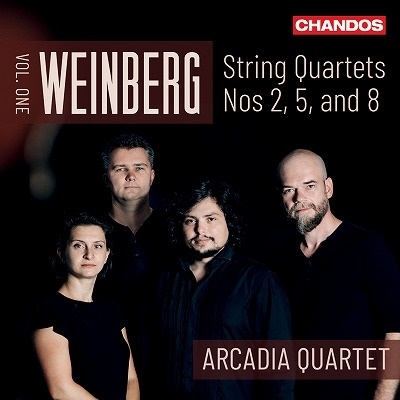
アルカディア弦楽四重奏団第2弾!
ヴァインベルクの弦楽四重奏曲集スタート!
ルーマニアのエキサイティングなクヮルテット、アルカディア弦楽四重奏団によるミェチスワフ・ヴァインベルク(1919-1996)の弦楽四重奏曲集!彼らはヴァインベルクの四重奏曲を熱烈に支持しており、「ヴァインベルクの音楽は、未知の闇に囲まれた光の輝きのようなものであり、その影を薄くすることが我々の目標になりました。」と語っています。
ヴァインベルクの17曲の弦楽四重奏曲の創作は、ワルシャワでの学生時代からモスクワでのキャリアの終わりまでの半世紀近くに及んでおり、彼の作曲家としての成長を他のどのジャンルよりも明確に示しています。第2番はミンスクで学んでいた1939年から40年にかけて作曲されたもので、作曲者の母と妹に捧げられています。(母と妹はドイツ軍のポーランド侵攻によってすでに命を落としていましたが、ヴァインベルクはそれを知ったのは後のことでした。)1945年に作曲された第5番は、各楽章にタイトルを付けた最初の四重奏曲で、親交の深かったショスタコーヴィチの影響を受けています。第8番はボロディン四重奏団に捧げられた単一楽章の作品です。
アルカディア弦楽四重奏団は、2006年にルーマニアのゲオルゲ・ディマ音楽アカデミーの生徒たちによって結成。2009年ハンブルク国際室内楽コンクール、2011年アルメレ国際室内楽コンクール、2012年ウィグモア・ホール・ロンドン国際弦楽四重奏コンクール、そして2014年の大阪国際室内楽コンクールで優勝し、同世代のもっともエキサイティングな弦楽四重奏団のひとつとして活躍しています。
東京エムプラス
発売・販売元 提供資料(2020/11/19)
The musical reputation of Mieczyslaw Weinberg has been steadily on the rise, with performances of his symphonies and now a new cycle of his string quartets underway at the hands of the Arcadia Quartet. The quartets trace Weinbergs compositional development, especially in the first part of his career from which two of the three quartets here come. The String Quartet No. 2, Op. 3, was composed in Minsk in 1939 and 1940 and is a tuneful work (albeit with a nagging sense of uncertainty typical of its time) thats well suited to the Arcadias warm sound. By 1945, when he composed the String Quartet No. 5, Op. 27, Weinberg had come into the orbit of Shostakovich. What becomes clearer from many Weinberg releases is that the influence went not only from Shostakovich to Weinberg, but often, the other way around, and the Arcadia Quartet brings this out in their playing with richly melodic, melancholy lines. Their performance of the three-movement String Quartet No. 8 in C major, Op. 66, probably the best known of Weinbergs quartets in the West, is clean and elegant, but it is the Fifth Quartet thats the real news here. Consider its first two movements, with their unsettling juxtaposition of deep sadness and a retreat into classic repose. Its pure Shostakovich, yet Shostakovich wasnt doing this kind of thing much by 1945. The second-movement Humoreske, seemingly a light, serenade-type piece until it begins to grimly harp on its main rhythm, is especially compelling, and its followed by a furious Scherzo of which the Arcadia takes the full measure. The acoustics of Suffolks Potton Hall have rarely been put to better use than they are here by engineer Jonathan Cooper, with the subtle polyphonic touches in Weinbergs writing emerging in full color. Listeners may prefer other cycles for individual quartets, but the Arcadia is off to a very strong start, with performances that show deep insight into these particular works.
Rovi