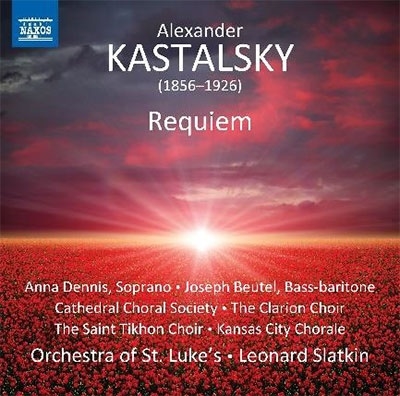
モスクワ音楽院で学び、合唱作品作曲家として活躍したアレクサンドル・カスタルスキー(1856-1926)。1891年には長い歴史を持つ「モスクワ聖務会院合唱団」の指導者となり、ラフマニノフやグレチャニノフらに強い影響を与えています。この「レクイエム~斃(たお)れし盟友たちのために」は第一次世界大戦によってもたらされた命の損失と、世界の荒廃を憂えた作曲家による大規模な合唱を伴うオーケストラ作品。1915年に12楽章のヴァージョンとして書き上げられたものの、初演後にカスタルスキーが楽章を追加し17楽章からなる壮大な作品として完成を見ました。レクイエムの定型をとりながらも、さまざまな要素がモザイクのように配置されており、いくつかの異なる国の言葉とグレゴリオ聖歌が入り混じる中、息子を亡くした母親や夫を亡くした未亡人のすすり泣きが織り込まれ、遠くからは第一次世界大戦に巻き込まれた日本やインドを表すモチーフも聞こえてきます。スラットキンは作品に漲る「戦争への怒りと悲しみ」を丁寧にすくい上げ、迫真の音楽として聴かせます。 (C)RS
JMD(2020/07/09)
モスクワ音楽院で学び、合唱作品作曲家として活躍したアレクサンドル・カスタルスキー(1856-1926)。1891年には長い歴史を持つ「モスクワ聖務会院合唱団」の指導者となり、ラフマニノフやグレチャニノフらに強い影響を与えています。この「レクイエム~斃(たお)れし盟友たちのために」は第一次世界大戦によってもたらされた命の損失と、世界の荒廃を憂えた作曲家による大規模な合唱を伴うオーケストラ作品。1915年に12楽章のヴァージョンとして書き上げられたものの、初演後にカスタルスキーが楽章を追加し17楽章からなる壮大な作品として完成を見ました。レクイエムの定型をとりながらも、さまざまな要素がモザイクのように配置されており、いくつかの異なる国の言葉とグレゴリオ聖歌が入り混じる中、息子を亡くした母親や夫を亡くした未亡人のすすり泣きが織り込まれ、遠くからは第一次世界大戦に巻き込まれた日本やインドを表すモチーフも聞こえてきます。スラットキンは作品に漲る「戦争への怒りと悲しみ」を丁寧にすくい上げ、迫真の音楽として聴かせます。
ナクソス・ジャパン
発売・販売元 提供資料(2020/07/07)
Composer Alexander Kastalsky, although he was Rachmaninovs teacher, is not well known outside Russia. He wrote mostly church music, and it influenced his famous student and other Russian church composers of the era. This Requiem of 1917 is unique, even within his oeuvre. Its a grand attempt to write a requiem mass for soldiers of the allied nations of World War I. As such, the mass was an evolving piece of work. At the end of the war, Kataslsky added sections for the United States, Japan, and India, but as Communism took hold, these were barred from performance, and whats given here, with 17 movements in all, is the world premiere of the full work. One might argue that as pure music, the Requiem isnt unified in the way that, say, a Beethoven symphony is; its not pure music, and theres something both powerful and consoling about Kataslskys attempt to encompass the scope of the war. The various sections refer musically and textually to Orthodox church music of Russia and Serbia, to the Catholicism of France and Italy, and to the Anglican music of Britain, with the non-Russian traditions just slightly filtered through Kataslskys homegrown lens. The original languages are used, with the result that few hearers would understand the entire text of the work. (Even his Russian pieces are not that intensely Russian, making no use of the deep basses heard in the Rachmaninov Vespers, for instance.) Things get a bit more unusual with the American Movement, which is based on the hymn Rock of Ages (yes, originally British, but recognized as characteristically American even in Russia in 1917), combined with the Chopin Funeral March from the Piano Sonata No. 2 in B flat minor, Op. 35. This is essential listening! Conductor Leonard Slatkin does a superb job holding and melding together a variety of choirs, and leading the Orchestra of St. Lukes: the performance could easily not have cohered as well as it does. An offbeat work that was well worth retrieving from the scrap heap of history; others will perform it again, but Slatkin has set the bar very high here.
Rovi