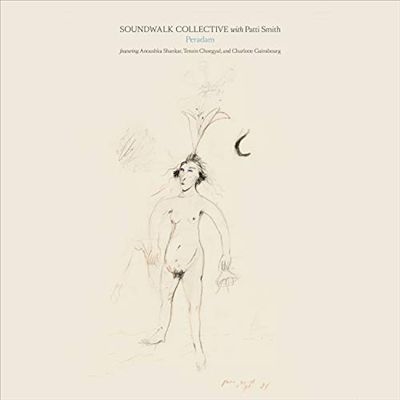
Peradam concludes the Perfect Vision trilogy of collaborative albums between musical psychogeographers Soundwalk Collective and Patti Smith. All are sonic inquiries into the exploratory travels of three French writers and contain field recordings from the places these writers sojourned. The first two, Peyote Dance and Mummer Love, were issued in 2019. The former was inspired by poet, dramatist, and actor Antonin Artauds travels to Sierra Tarahumara, Mexico, where he observed and partook of the indigenous peoples spiritual rituals. The latter took poet Arthur Rimbauds sojourn in Harar, Ethiopia as its muse. In each case, the Soundwalk Collectives Stephan Crasneanscki and Simone Merli traveled to these locales and recorded the world around them. They brought their field-recorded, studio-manipulated sounds to Smith, who added intuitive readings of their works, imparting the illuminating experiences reflected in their texts, all inside a native universe of sound. Peradam draws on the writings of literary and psychic traveler Rene Daumal, in particular his unfinished and influential novel Mount Analogue. Daumal traveled to India in a search of the peradam, his conception of a rare, crystalline stone that harbors profound truths, and is only visible to true spiritual seekers. The novels text in both French (delivered by Charlotte Gainsbourg) and English translations, is utilized here. Soundwalk Collective traced Daumals steps through his travels to the Nanda Devi in the Himalayas, Rishikesh, Varanasi, and the secluded Kingdom of Lo (Upper Mustang) to channel his metaphysical quest.
Nanda Devi commences with the ever-present roaring wind across the Himalayan slopes. Sherpa Dhan Singh Rana chants an invocation to the bliss-giving goddess of the mountain in Hindi. On Peradam, Smith reads excerpts from Daumals G.I. Gurdjieff-influenced texts and translations from the Sanskrit over the sounds of Tibetan damaru, sampled beats, bells, gongs, and vocal chants. She intones that she will not speak of the mountain before the journey makes her one with its deity. Knowledge of the Self is introduced with night sounds and Anoushka Shankars sitar; it hovers above the environmental sounds before Smith unfolds Daumals cautionary instructions for the spiritual journey. The scattershot percussion and nearly imperceptible drones in Spiritual Death allow her room to expose the beginners mind to frustrating yet ultimately instructive eternal truths. In The Four Cardinal Times, Gainsbourg whispers a text cyclically in French before Smith reads another in English. Their cadences are staggered amid night sounds, harmonium, and ambient drones and are eventually combined with incantatory power. Sounds here are primarily ambient and unintrusive; they border on becoming boring, but dont succumb. They insinuate meaning and illuminate Smiths interpretive, rhythmic readings; they frame both her voice and its annunciations, which are layered with hidden meanings. While some may find the two earlier volumes more satisfying due to more dramatic presentations, the Perfect Vision trilogy needed Peradams gentler, decidedly more exploratory texts of a dangerous spiritual quest and discovery to come full-circle. Framed by field-recorded eloquence, Smiths voice delivers on that potential. ~ Thom Jurek
Rovi