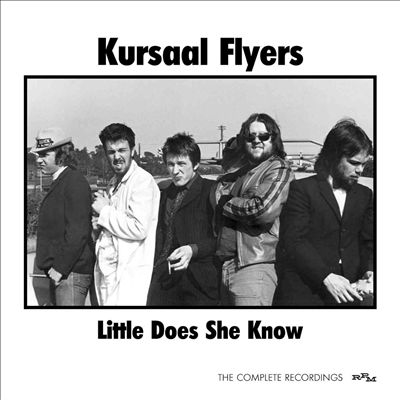
In the days before punk rock, Kursaal Flyers straddled the line separating pub rock and power pop. The line was so thin it would seem to disappear in the rearview mirror, but when Kursaal Flyers were active in the mid-70s, they were subtly pulled in two different directions. Theyd tour on the same circuit as their friends Dr. Feelgood, but they also signed to Jonathan Kings company in 1975, then worked with pop impresario Mike Batt after singing to CBS for The Golden Mile in 1976. Batt gave Little Does She Know a grandiose arrangement designed to conjure memories of Phil Spector, and it was enough for the single to crack the U.K. Top 20; however, instead of being their breakthrough, it was their only hit. The band made it through 1977, playing harder and faster on-stage, an evolution captured on their incandescent 77 single Television Generation -- a pop record with its eyes on punk, not the 1960s -- but lead singer Paul Shuttleworth decided to go solo by the end of the year. Kursaal Flyers disbanded after his departure -- drummer Will Birch went on to form the Records, who cut the power pop classic Starry Eyes -- but they reunited in the mid-80s, a resurrection that resulted in 1988s A Former Tour de Force Is Forced to Tour.
All of this music is boxed up on RPMs 2020 quadruple-disc set Little Does She Know: Complete Recordings, which not only contains the aforementioned albums but the two albums the group made for King (Chocs Away and The Great Artiste), the ripping 1977 concert album Five Live Kursaals, plus a handful of singles, stray tracks, unreleased songs, and radio sessions. Listening to the collected work of the Kursaals accentuates how they were torn between their country-tinged roots and pop inclinations. Often, the bands studio productions were a shade too bright and polished for the material, but theres a charm in how the group gamely attempted to hit the charts, plus underneath the gloss there are a number of remarkable songs, usually written by the combination of Will Birch and Graeme Douglas. A lot of these songs are best heard on Five Live Kursaals, which is leaner and meaner than the studio set, but its also true that the clutch of 1977 studio recordings that also spawned the Birch/Richie Bull composition Television Generation are immediate in a way that the earliest Kursaal records arent. Still, the amiable country-rock and pop of the three studio albums is charming and often effective -- and, in the case of Speedway, quite brilliant -- but its also easy to see why Douglas calls A Former Tour de Force the groups best recordings in Birchs liner notes. On this reunion record, the two sides are integrated and the Kursaals are not only focused but having fun, and that means this box is the rare set where the latter-day recordings help shine a light on what the group did so well. ~ Stephen Thomas Erlewine
Rovi