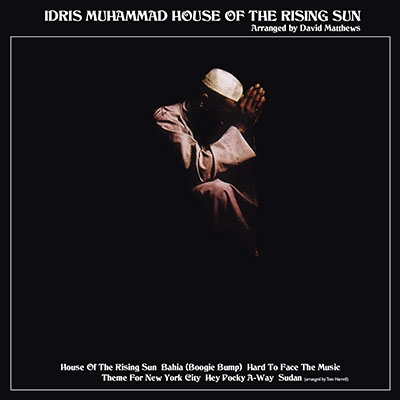
Idris Muhammad's "House Of The Rising Sun" is a delightful throwback to the glory days of the disco Music. It ranks among the best albums ever recorded by the maverick drummer. The album contains a funked up "Chopin" cover, "Theme From New York City", the down and dirty ultra-funkafied cover of "Hey Pocky A Way", "Pipe Stem" (a Latin-jazz flavoured Muhammad original), and "I Know You Don't Want Me No More" (pure soul-fusion). Absolute highlight of the album is the awesomely seething instrumental "Sudan", the only other Muhammad original on the album. What this man does behind the kit on this cut is absolutely astounding. Featured Musicians Include Eric Gale, Don Grolnick, and David Sanborn.
発売・販売元 提供資料(2020/03/02)
Idris Muhammad's House of the Rising Sun is a legendary soul-jazz album, and for good reason. First there's the fact that, Grady Tate notwithstanding, Idris Muhammad is easily the greatest of all soul-jazz drummers. Next, it is revealed that label boss and producer Creed Taylor was at his most inspired here, and wasn't afraid to err on the rhythm and blues side of the jazz equation. The material is top-notch, and David Matthews, who orchestrated and arranged this date with the exception of one track -- "Sudan" was written by Muhammad and Tom Harrell, and Harrell arranged it -- was on fire. As a bandleader, Muhammad is shockingly effective. Not because one could ever doubt his ability, but because of his reputation as one of the great studio drummers in jazz. Finally, this is the single greatest lineup in Kudu's history, and features the talents of Don Grolnick, Eric Gale, Will Lee, Roland Hanna, Joe Beck, David Sanborn, Michael Brecker, Hugh McCracken, Bob Berg, Fred Wesley, Patti Austin, and a dozen others playing their asses off. From the title track which opens the album, with Austin reaching the breaking point in her delivery, to the stunningly funky groove in Ashford and Simpson's "Hard to Face the Music," to the minor key funk of the Chopin-adapted theme in "Theme for New York City," to "Sudan"'s triple-timed drums and killer Eastern-tinged hooks, and a read of the Meters' "Hey Pocky A-Way," with Eric Gale's dirty finger poppin' bass atop McCracken's bluesed-out slide work, this is a steaming, no let-up album. Add to this a gorgeous version of the Ary Barroso Brazilian jazz classic "Bahia," and you have the set for a classic jazz album. But the complete disregard for the political correctness of "Jazz" itself, in order to get the deeply funky and soulful grooves across, is what makes this set so damn special and even spiritual in its inspiration. Jazz purists lost all credibility when they slagged this one off, caught as they were in tainted, even racist views of the past that made no allowances for jazz musicians to actually follow their time-honored tradition of mining the pop music of the day to extend the breadth and reach of jazz itself. Anybody who wants to believe that George Gershwin is somehow more important than George Porter Jr. is already lost in his own cultural fascism. Muhammad, who understands this better than anyone, pulled out all the stops here and blasted out one amazingly tough, funky slab. Brilliant. ~ Thom Jurek
Rovi