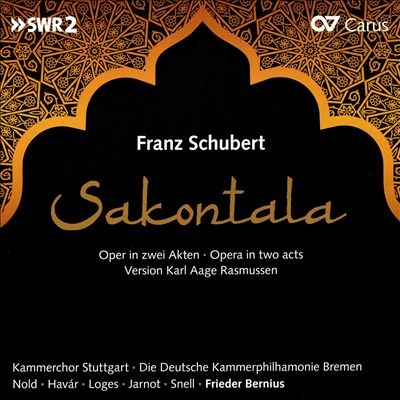
Franz Schubert completed about 16 works roughly described as belonging to the category of opera; only three were produced in his lifetime, enjoying no more than moderate success. When Schubert's operas are recorded, though infrequently, one often encounters some statement to the effect of "this overlooked opera is Schubert's one masterpiece in the genre," and indeed, both Alfonso und Estrella (1820) and Fierabras (1823) have gained a tenuous toehold in the revival repertory. No one has ever tried to make such a claim about Sakuntala (1820), which is an unfinished, but substantial, sketch for an opera based on a German version of Kalidasa's fourth century Sanskrit play The Recognition of Shakuntala -- a favorite of Goethe -- fashioned by Schubert's friend Johann Philipp Neumann. As late as 2000, one writer quipped "[Sakuntala] remains to this day the one and only Schubert stage work of which not one note has been performed for the public, anywhere, ever." Nevertheless, even by that time, it had already been heard twice; in 1971 in Vienna and realized as a ballet in Munich in 1979. Director Jorn Thiel filmed this production for German television, which featured the Mallika Sarabhi Dance Company of India.
Karl Aage Rasmussen's 2002 realization -- not "reconstruction" as dubbed by Carus-Verlag in its recording of the finished result, as Schubert did not himself create a practical score -- of Sakuntala approached the work as though these earlier attempts did not exist, and indeed, Rasmussen may not have known about them. Rasmussen's examination of Schubert's hefty, 400-page manuscript made some determinations not noticed before; although often described as "opera in three acts, with sketches of acts one and two only," Rasmussen determined that Schubert only intended two acts, and that in a purely vocal sense his score was complete. The accompaniment, however, was only roughly sketched in, and bare for long stretches of the music, and Schubert's text underlay was compromised by the difficulty in reading his "Gothic" script. This was soon fixed by the discovery by librarian Thomas Aigner of Neumann's long-lost original play. In the end, Rasmussen claims he only had to fill in the blanks in relatively short stretches, and what we hear in Sakontala -- Carus-Verlag's spelling of the title -- is essentially Schubert's.
The recording, which is live from the Stadthalle Metzingen and from 2006, is disappointingly canny sounding and constricted, but one gets used to the sound as the show progresses. The singing is OK but not particularly distinguished; the chorus is good, though the Deutsche Kammerphilharmonie Bremen under Frieder Bernius seems a little underpowered and is definitely under-recorded. Rasmussen notes a similarity between Sakuntala and Carl Maria von Weber's Der Freischutz, premiered not long after Schubert abandoned Sakuntala for good. One could go further and state that it also bears some commonality of approach with Weber's Abu Hassan (1810) given its Viennese take on orientalism, an idiom no doubt familiar to Schubert, if somewhat outside his comfort zone. Parts of it also vaguely resemble Mozart, but this appears to be in sections where there isn't much accompaniment to work with. Rasmussen states that he deliberately avoided attempting to "compose like Schubert," and one wishes he had tried; in such passages, it is obvious that Schubert's harmony would be a little richer and more eccentric, and his preference for certain rhythmic patterns almost suggest themselves, though Rasmussen would have none of it. The best parts of the reconstruction are the Finale of the first act and the first numbers of the second; the first act Finale runs nearly 30 minutes and seems mostly filled in by the composer. It is a strange, disorienting experience to hear pseudo-oriental modes and rhythms winding their way through Schubert's usual idiom. Like his other operas, Sakuntala is not free of its share of gaffes; the secon to be continued...
Rovi