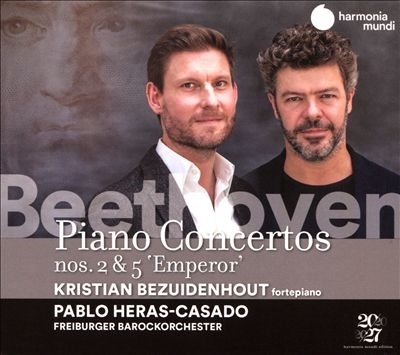
ベザイデンホウト&エラス=カサド&FBO
ベートーヴェン:ピアノ協奏曲プロジェクト第1弾!
軽やかに飛翔する音楽で世界を魅了するベザイデンホウト、オーケストラを豊かに響かせつつ細やか、かつグルーヴ感のよい指揮で世界を舞台に活躍するエラス=カサド、そして名人集団フライブルク・バロック・オーケストラという望みうる最高の顔合わせによるベートーヴェンの協奏曲全曲シリーズの登場です!
2015年3月に協奏曲第3番を共演、その時にぜひこの顔合わせで全曲録音を、というプロジェクトが立ち上がりました。2017年12月、10日間で一挙に5曲を録音する、というスケジュールで、皆がベートーヴェンにどっぷりつかった幸せな10日間だったといいます。最新の校訂報告にも入念にあたり、これまで見過ごされてきたアーティキュレーションやデュナーミクを忠実に表現し、よりすみずみまで行き届いた演奏となっています。
「皇帝」冒頭のオーケストラのやわらかさをそなえた力強い響きに、はっと驚かされます。つづくベザイデンホウトが奏でる軽やかかつ華やかなパッセージに、ベートーヴェン当時の人々が感じたであろう衝撃と期待感をおぼえます。緩徐楽章でのベザインデンホウトの美しさは言うまでもなく、終楽章での細やかさと歯切れのよさ、そしてエラス=カサド率いるFBOの合いの手の絶妙加減も素晴らしいものがあります。第2番ではオペラ序曲のような浮き浮きとした冒頭、緩徐楽章でのソロとオーケストラとの親密な対話、終楽章の小気味よいテンポ感、何をとっても絶品です。第1楽章のカデンツァは、ベザイデンホウトたっての願いで、ガーディナー(オルケストル・レヴォリュショネル・エ・ロマンティーク)とロバート・レヴィンが1999年にリリースした同曲の録音において、レヴィンが即興でおこなったカデンツァを元にしたものが収録されていますが、これがまた超絶技巧と豊かな音楽が見事に発揮されたものとなっており、聴きものです。ソリスト、オーケストラのメンバー一人ひとりの腕前が素晴らしく、それを束ねる指揮者の音楽性すべてが見事に作用し合ってこそ実現しえた稀有の名演が展開されています。
キングインターナショナル
発売・販売元 提供資料(2020/01/10)
Searching for clues in the historical record of how Beethoven played his first four piano concertos, Kristian Bezuidenhout considered the spontaneous nature of some of the premiere performances, and has extrapolated options for his own interpretations. Beethovens cadenzas were initially improvised, emulating Mozarts practice, and this contributed to his reputation as a pianist to watch in the late 1790s. Reflecting Beethovens eagerness to impress the public with demonstrations of his exceptional virtuosity and invention, the early concertos quickly made him a celebrity in Vienna and across Europe. For this 2020 release on Harmonia Mundi, Bezuidenhout joins Pablo Heras-Casado and the Freiburger Barockorchester in period style performances of the Piano Concerto No. 2 in B flat major, Op. 19 (1798), which Beethoven played, and the Piano Concerto No. 5 in E flat major, Emperor, Op. 73 (1809), which he did not, having become profoundly deaf by that time and unable to hear the orchestra or his own part. Bezuidenhout plays a fortepiano, a modern copy of an 1824 Graf instrument, and he is accompanied by a small but robust chamber orchestra that permits a fair competition with the lean, metallic sound of the keyboard. This works reasonably well in the Piano Concerto No. 2, where the music accords with this balance, and Bezuidenhout plays his transcription of Robert Levins improvised cadenza, which was recorded in 1999 with John Eliot Gardiner and the Orchestre Revolutionnaire et Romantique. However, the sound of the fortepiano seems at times insufficient for the Emperor, which is cast in Beethovens heroic mold and seems unnecessarily thin and tinny in this recording, despite the opportunity Bezuidenhout had to use a different and stronger sounding instrument, which he turned down for musical and logistical reasons. Harmonia Mundis recording is clear and focused, and tends to favor the orchestra over the fortepiano, especially in the Piano Concerto No. 5.
Rovi