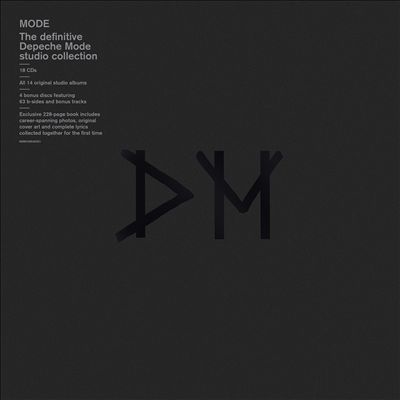
Collecting nearly four decades of material in one stylish package, Depeche Mode delivers their most comprehensive studio collection to date with the MODE box set. A whopping 18 discs worth of music, MODE charts the bands evolution from their debut studio recording (the pulsing synth-pop Photographic from the 1981 Some Bizzare Album compilation) all the way to an electronic-washed cover of David Bowies Heroes recorded live during their Spirit era. All 14 of their studio albums are included, packaged in sleek and stylish black sleeves with the original artwork darkened to match. In addition to the convenience of having every LP in one place, MODE justifies its existence on the back end, with four discs worth of material -- titled M, O, D, and E, naturally -- that collects 63 B-sides, remixes, standalone singles, and compilation bonus tracks. Each disc provides a great snapshot of the general era in question, bridging their pop, alternative, and electronic sides in smooth succession. While almost everything here has been available in some form somewhere else for quite some time, having it all in one place is an ideal way to discover additional period treasures and enjoy them in the proper chronological context.
M kicks off with Depeche Modes earliest material with Vince Clark and slowly gets darker over the course of their first four albums (Speak & Spell, A Broken Frame, Construction Time Again, and Some Great Reward). In addition to Photographic (Some Bizarre Version), M also includes highlights Sometimes I Wish I Was Dead (Flexi-Pop Mix), In Your Memory, Its Called a Heart, Shake the Disease, Fly on the Windscreen, and Get the Balance Right! As the mood shifts on the second disc, O, Depeche Mode hits what is arguably their cultural peak, the triumphant span from 1986s Black Celebration to 1990s Violator. This fertile period yields some of the best bonus material on MODE, including the classical breaks Stjarna and Sonata No. 14 in C#m (Moonlight Sonata); the moody instrumentals Memphisto and Sibeling (from the Enjoy the Silence singles), and fan favorites Pleasure, Little Treasure and Route 66. D casts a wider net, spanning 1993s Songs of Faith and Devotion all the way to 2005s late-career peak, Playing the Angel. The uneven nature of this disc is reflective of the groups real-life turbulence, as longtime member Alan Wilder made his departure and frontman Dave Gahan plummeted further into his downward spiral of addiction. While Songs only gets one moment to shine with My Joy, the Only When I Lose Myself single contributes not only that non-album single (bundled with the 1998 compilation The Singles 86>98) but also a pair of other highlights (Surrender and Headstar). The expansive electronics on those latter tracks segue perfectly into their course-shifting rebirth on 2001s Exciter, which pushes the trio down an even more experimental and atmospheric path. Fans of Playing the Angel are gifted with the pulsing Newborn and Martyr, so good they could have been included on the album. Closing with E, Depeche Mode quickly wraps up the bonus material with two of their less impressive albums, Sounds of the Universe (2009) and Delta Machine (2013). More than half of the tracks are mined from the Sounds deluxe box and, like the Ultra B-sides, they provide more insight into a period that might be overlooked in favor of stronger classics, but which nevertheless contains a bevy of hidden gems. The throbbing Oh Well is presented in two versions, all the better for this standout, while Martin Gore gets his requisite time to shine with a typically gorgeous solo moment, The Sun and the Moon and the Stars. The set ends with the one-and-only previously unreleased song, that Bowie Heroes cover, which joins the famed Hansa studios alumni in a moving moment recorded in New York City during the promotion of 2017s Spirit.
Arriving the same year that these electronic trailblazers were inducted into the Rock and Roll Hall of Fame, MOD to be continued...
Rovi