Mojo - 4 stars out of 5 -- "Imagine, if you will, Schubert's Winterreise hijacked by Thomas Ligotti and Jan Svankmajer and you won't even be close to fathoming the unearthly beauty of this recording."
The Wire - "It all works, and gloriously so. These are beautiful songs, sung beautifully, with beautiful accompaniment. Foster's famously wayward, reverb-soaked vocal intensity draws us deeper into her own particular kind of darkness."
Rovi
For her third solo album, Josephine Foster went for something simple, but extremely strange. Basically, A Wolf in Sheep's Clothing consists of renditions of 19th century art songs, with Brian Goodman's acid electric guitar providing the X factor. Foster has selected pages by Schubert, Schumann, and Brahms, which she sings in German, in typical lieder fashion (acute vibrato included), accompanying herself soberly at the acoustic guitar. Upon hearing the first few seconds of "An die Musik," the first track, you cannot help but wonder if you have put the right disc in the CD player -- is this a reissue of some old wax recordings miraculously restored? -- at which point the electric licks kick in and things take an unmistakable contemporary feel. Goodman seems to operate on his own level, weaving acid lines in and out of the songs, often with little relation to them. The contrast is downright shocking at first and remains disquieting for the first four songs. By the fifth track, "Wehmut," Foster changes her approach: an old piano replaces the acoustic guitar, while amateur harmonica and other miscellaneous instruments create something much closer to the free folk aesthetics some listeners are probably expecting from this album. The longest piece by far, "Auf Einer Burg" goes further in that direction, retaining only the ghost of Schumann's original melody, obscured by reverb and drenched in multi-tracked psychedelic guitar improvisations. The dislocation felt in the earlier tracks is dispelled in this case, which, paradoxically, makes this piece the "saner" one of the bunch and also the least effective. "Nahe Des Geliebten" comes back to the arrangements of the first few songs, closing the album on a more positive note. Some fans of Foster will argue that her two previous solo albums hinted at something like this -- Hazel Eyes, I Will Lead You had a certain antiquated quality to it -- but nothing can really prepare you for A Wolf in Sheep's Clothing. People who make up lists of "weird albums" will most likely take a shine to this one, but don't look at it as a novelty record; it has unique charm and can unexpectedly grow on you. ~ Francois Couture|
Rovi
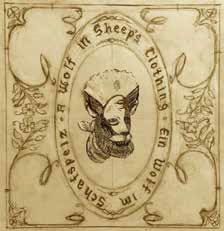
For her third solo album, Josephine Foster went for something simple, but extremely strange. Basically, A Wolf in Sheep's Clothing consists of renditions of 19th century art songs, with Brian Goodman's acid electric guitar providing the X factor. Foster has selected pages by Schubert, Schumann, and Brahms, which she sings in German, in typical lieder fashion (acute vibrato included), accompanying herself soberly at the acoustic guitar. Upon hearing the first few seconds of "An die Musik," the first track, you cannot help but wonder if you have put the right disc in the CD player -- is this a reissue of some old wax recordings miraculously restored? -- at which point the electric licks kick in and things take an unmistakable contemporary feel. Goodman seems to operate on his own level, weaving acid lines in and out of the songs, often with little relation to them. The contrast is downright shocking at first and remains disquieting for the first four songs. By the fifth track, "Wehmut," Foster changes her approach: an old piano replaces the acoustic guitar, while amateur harmonica and other miscellaneous instruments create something much closer to the free folk aesthetics some listeners are probably expecting from this album. The longest piece by far, "Auf Einer Burg" goes further in that direction, retaining only the ghost of Schumann's original melody, obscured by reverb and drenched in multi-tracked psychedelic guitar improvisations. The dislocation felt in the earlier tracks is dispelled in this case, which, paradoxically, makes this piece the "saner" one of the bunch and also the least effective. "Nahe Des Geliebten" comes back to the arrangements of the first few songs, closing the album on a more positive note. Some fans of Foster will argue that her two previous solo albums hinted at something like this -- Hazel Eyes, I Will Lead You had a certain antiquated quality to it -- but nothing can really prepare you for A Wolf in Sheep's Clothing. People who make up lists of "weird albums" will most likely take a shine to this one, but don't look at it as a novelty record; it has unique charm and can unexpectedly grow on you.
Rovi
For her third solo album, Josephine Foster went for something simple, but extremely strange. Basically, A Wolf in Sheep's Clothing consists of renditions of 19th century art songs, with Brian Goodman's acid electric guitar providing the X factor. Foster has selected pages by Schubert, Schumann, and Brahms, which she sings in German, in typical lieder fashion (acute vibrato included), accompanying herself soberly at the acoustic guitar. Upon hearing the first few seconds of "An die Musik," the first track, you cannot help but wonder if you have put the right disc in the CD player -- is this a reissue of some old wax recordings miraculously restored? -- at which point the electric licks kick in and things take an unmistakable contemporary feel. Goodman seems to operate on his own level, weaving acid lines in and out of the songs, often with little relation to them. The contrast is downright shocking at first and remains disquieting for the first four songs. By the fifth track, "Wehmut," Foster changes her approach: an old piano replaces the acoustic guitar, while amateur harmonica and other miscellaneous instruments create something much closer to the free folk aesthetics some listeners are probably expecting from this album. The longest piece by far, "Auf Einer Burg" goes further in that direction, retaining only the ghost of Schumann's original melody, obscured by reverb and drenched in multi-tracked psychedelic guitar improvisations. The dislocation felt in the earlier tracks is dispelled in this case, which, paradoxically, makes this piece the "saner" one of the bunch and also the least effective. "Nahe Des Geliebten" comes back to the arrangements of the first few songs, closing the album on a more positive note. Some fans of Foster will argue that her two previous solo albums hinted at something like this -- Hazel Eyes, I Will Lead You had a certain antiquated quality to it -- but nothing can really prepare you for A Wolf in Sheep's Clothing. People who make up lists of "weird albums" will most likely take a shine to this one, but don't look at it as a novelty record; it has unique charm and can unexpectedly grow on you. ~ Francois Couture
Rovi