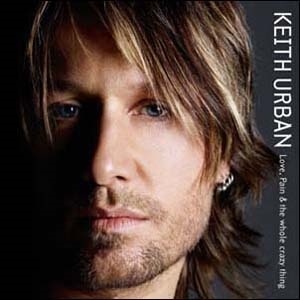
Rolling Stone (p.124) - 3.5 stars out of 5 -- "Imagine Daryl Hall with Nashville guitar skills and an Australian's fascination with Southern culture, and you have Keith Urban....He's accomplished in ballads, unafraid to scuff up his smoothness."
Entertainment Weekly (p.79) - "Urban has a flexible tenor voice, with just a hint of rasp in it; he excels at singing ballads..." -- Grade" B-
Rovi
Love, Pain & the Whole Crazy Thing was released on November 7, 2006, just days after Keith Urban voluntarily entered an alcohol treatment center. Having married actress Nicole Kidman just months before, his timing couldn't be better. After all, Urban is trying to get well at the very peak of his life thus far, both personally and professionally, and an album this enjoyable needs a healthy person to support it. Love, Pain & the Whole Crazy Thing is slicker than anything Urban has issued before, but it's also more ambitious, representing a giant leap forward from 2004's Be Here. Urban is a rocking guitarist, a complete wildman on the electric six-string, and he combines his tough, unhinged approach to the instrument with pop melodies and utterly brilliant production elements that layer strings, drum loops, fiddles, banjos, E-Bows, and Hammond B-3s. Add a songwriting style that touches on the classic elements of rock, country, and mainstream pop, and you have something that hasn't been heard in the country genre in such a cohesive way before. That's right -- the album is further proof of Urban's ability to stretch the genre to the breaking point by bringing in more of modern pop's elements, while remaining firmly within Nashville's good graces.
Song by song, this albums feels as if there isn't anything he can't do. Sharing production credit with Dan Huff, Urban wrote (or, in some cases, co-wrote) ten of the album's 13 cuts -- there's a hidden track buried in the CD-ROM portion of the disc. The production is thoroughly modern, but also feels like the country equivalent of George Martin. It's positively baroque in places, and there is so much packed in that it almost feels claustrophobic, even though he makes it work beautifully. No record since Neil Diamond's brilliant Beautiful Noise -- produced by the Band's Robbie Robertson -- has sounded so regal and inviting. The album's first single, "Once in a Lifetime," opens the set; it entered the Billboard chart at number 17, the highest debuting single since the chart's inception. But the shock is simply that it's not the best track on the record. Urban has packed this disc with fine writing and excellent, even defining versions of the songs he chose to cover. There are a number of rockers, including "Faster Car," with its smoking, funky bassline, layered power chords, and his "ganjo" that rings above the horn section, and "I Told You So," which uses acoustic guitars, fiddles, and the ganjo to usher in some twisting, minor-key electrics. Both songs are based on tight little hooks, and both build to the breaking point while allowing Urban's voice to soar above the instruments. On the latter tune, Uilleann pipes and bouzouki are layered into the mix in a melody that brings to bear Celtic cowboy lyric frames and tribal rhythms. The whole thing explodes near the end, when Urban cuts loose in a serious, distortion-laden guitar wrangle.
"Shine," which begins as a shimmering country-pop tune, is another example, as a string section and his unhinged soloing battle for dominance in the nearly unbearable climax. "I Can't Stop Loving You," written by Billy Nichols, is another climatic tune, but it becomes one of the great modern country love songs with its incessant reaching to its crescendo, which is provided by an army of strings and big power chords. "Used to the Pain," written with Darrell Brown, is a stealthy rocking love song that drips with emotion. The down-home anthem "Raise the Barn," a duet with Ronnie Dunn, was written in reaction to the destruction done by Hurricane Katrina. Urban can also write a shuffling country-rocker with the best of them. Urban didn't pen "God Made Woman," but his version makes the track his own. Beginning with a choir (somewhat smaller and yet reminiscent of the Rolling Stones on "You Can't Always Get What You Want"), the cut quickly becomes a loud and proud country-rock anthem that celebrates -- not objectifies -- women. "Tu Compania" is to be continued...
Rovi
前作は300万枚超のベストセラー、ニコール・キッドマンとの結婚も話題になったカントリー歌手の新作。爽快なロック・サウンドが気持ちいいオープニングから、じっくり聴かせるアコースティック・バラード“I Can't Stop Lovin' You”、切ないヴォーカルのミディアム“Got It Right This Time”など、ワイルドでスウィートな作風はスター性に溢れている。甘いマスクも手伝って、日本でも話題になること間違いなし!
bounce (C)まちだ ゆうき
タワーレコード(2007年03月号掲載 (P95))