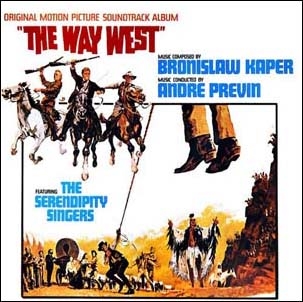
Bronislaw Kaper's music for The Way West (1967) was just about the last classic Western movie score ever written that was done in a broad, epic style without any sense of irony until John Barry's music for Dances with Wolves appeared two decades later. But Kaper's music comes from an even older tradition, dating to Dimitri Tiomkin's score for Red River (1948) and, in its use of choral music and folk melodies, to a theatrical tradition decades older than that, and the influence of such figures as Aaron Copland and Roy Harris. The Polish-born Kaper had scored a handful of Westerns in the previous decade and, perhaps recognizing the nature of time, mortality, and public taste, understood that The Way West might well be his last chance to deal with the American West in musical terms. The film was also, at least in its conception, one of the larger cinematic canvases of its kind that anyone was ever likely to see again. As it turned out, the screenplay, co-authored by former blacklistee Ben Maddow, left so many loose ends that one had the feeling that United Artists had sharply reduced the budget during production, so that what was seen on the screen was really three (or more) hours of plot jammed into a two-hour finished film. Kaper lived up to his expectations, however -- if his action themes didn't have the growl or drive of Tiomkin's music in similar circumstances, he made up for it with his expansive main title theme, which works equally well as an instrumental drenched in sonorous strings or as a choral piece (sung by the Serendipity Singers). Tracks such as "We're Crossing First," underscoring a fight to ford a river ahead of what appears to be another wagon train, follow in the same Copland-esque tradition as the title tune, and none of what's here is very distant from that composer's "Billy the Kid" or "Rodeo," or even his score for The Red Pony. "Flowers for Mr. Mack" is a more lyrical realization of the same tradition, and Kaper pretty much stays in that mode throughout "Water and Billy's Death," "Lige Celebrates," and the tragic "On to Crystal City." Other tracks, such as "Buffalos and Indians," are more densely textured and closer to European concert music. As the composer had no training at the podium, the score is conducted by Andre Previn, in one of his very last appearances as a Hollywood conductor before he moved permanently into the concert hall. The Serendipity Singers' other contribution, "Mercy McBee," is more in the tradition of their standard folk-pop sound, without the sheer power of the title track but with an engaging lyricism and delicacy (in the movie the song comes out appropriately rougher).
Given the obvious attention paid to the music, one of the ironies about The Way West as an album is that it had a major flaw in its original issue on United Artists Records. The track "I Killed Him (Execution)" always had a flaw which resulted in a shifting dropout between the two stereo channels, a defect that was repeated in the LP reissue from MCA -- and which was edited out, creating an artificial pause, in the EMI reissue; the latter CD also removed one other track entirely. Finally, in 2009, 42 years after the soundtrack's original release, producer Douglass Fake and Intrada Records re-released The Way West as a limited-edition CD, with that dropout repaired and all of the tracks restored. ~ Bruce Eder|
Rovi
Bronislaw Kaper's music for The Way West (1967) was just about the last classic Western movie score ever written that was done in a broad, epic style without any sense of irony until John Barry's music for Dances with Wolves appeared two decades later. But Kaper's music comes from an even older tradition, dating to Dimitri Tiomkin's score for Red River (1948) and, in its use of choral music and folk melodies, to a theatrical tradition decades older than that, and the influence of such figures as Aaron Copland and Roy Harris. The Polish-born Kaper had scored a handful of Westerns in the previous decade and, perhaps recognizing the nature of time, mortality, and public taste, understood that The Way West might well be his last chance to deal with the American West in musical terms. The film was also, at least in its conception, one of the larger cinematic canvases of its kind that anyone was ever likely to see again. As it turned out, the screenplay, co-authored by former blacklistee Ben Maddow, left so many loose ends that one had the feeling that United Artists had sharply reduced the budget during production, so that what was seen on the screen was really three (or more) hours of plot jammed into a two-hour finished film. Kaper lived up to his expectations, however -- if his action themes didn't have the growl or drive of Tiomkin's music in similar circumstances, he made up for it with his expansive main title theme, which works equally well as an instrumental drenched in sonorous strings or as a choral piece (sung by the Serendipity Singers). Tracks such as "We're Crossing First," underscoring a fight to ford a river ahead of what appears to be another wagon train, follow in the same Copland-esque tradition as the title tune, and none of what's here is very distant from that composer's "Billy the Kid" or "Rodeo," or even his score for The Red Pony. "Flowers for Mr. Mack" is a more lyrical realization of the same tradition, and Kaper pretty much stays in that mode throughout "Water and Billy's Death," "Lige Celebrates," and the tragic "On to Crystal City." Other tracks, such as "Buffalos and Indians," are more densely textured and closer to European concert music. As the composer had no training at the podium, the score is conducted by Andre Previn, in one of his very last appearances as a Hollywood conductor before he moved permanently into the concert hall. The Serendipity Singers' other contribution, "Mercy McBee," is more in the tradition of their standard folk-pop sound, without the sheer power of the title track but with an engaging lyricism and delicacy (in the movie the song comes out appropriately rougher).
Given the obvious attention paid to the music, one of the ironies about The Way West as an album is that it had a major flaw in its original issue on United Artists Records. The track "I Killed Him (Execution)" always had a flaw which resulted in a shifting dropout between the two stereo channels, a defect that was repeated in the LP reissue from MCA -- and which was edited out, creating an artificial pause, in the EMI reissue; the latter CD also removed one other track entirely. Finally, in 2009, 42 years after the soundtrack's original release, producer Douglass Fake and Intrada Records re-released The Way West as a limited-edition CD, with that dropout repaired and all of the tracks restored. ~ Bruce Eder
Rovi
颯爽、ウエスタン快作、イントラーダより。
『大西部への道』(1967)
サウンドトラック
音楽 ブロニスラウ・ケイパー
監督 アンドリュー・V・マクラグレン
主演 カーク・ダグラス、リチャード・ウィドマーク
ロバート・ミッチャム
1843年、オレゴンに多くの資源がある噂をもとに
人々のさまざまな思惑が巡る西部劇。監督は
『コマンド戦略』の男性派監督アンドリュー・V・
マクラグレン。語りから入る軽快な主題歌を歌うのは
セレンディピティ・シンガーズ。ケイパーといえば、
女性の機微を繊細に描くスコアも名作多いが、男性派
アクションも、この頃は立て続けに担当、壮大で躍動感
あふれるオーケストラ・スコアを聴かせる。指揮はアンドレ・
プレヴィン!アクション・シーンの小気味よさ、人間ドラマ
を描く際の流麗さ、職人たちの仕事ぶりがうかがえる。
収録曲はユナイトよりリリースされたLPと同じ。
(C)馬場敏裕
タワーレコード(2009/04/01)


 音楽ジャンル TOP
 本/雑誌/コミック TOP
 規格品番とは、日本レコード協会が定めた規格に基づき、CD・DVDなどの市販されているメディアに対して付けられたコードのこと。英数字4文字(記号)と数値1~5桁(シリアル番号)の組み合わせを用いる。


 DVD/ブルーレイ TOP
 グッズ TOP


 購入上の注意


