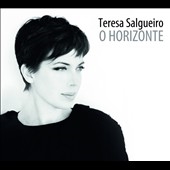
Back in 2012, Teresa Salgueiro inaugurated a new phase of her solo career with O Misterio, her first collection of original material. Its follow-up, O Horizonte, appeared only in 2016 after four years of extensive touring, a tribute to Mexican music titled La Golondrina y el Horizonte, and a long recording process. O Horizonte follows the same blueprint of its predecessor in terms of instrumentation (voice, guitars, accordion, double bass, drums) and composition (Salgueiro wrote all the lyrics on her own and co-wrote all the music with the members of her band). Even the fact that she changed half her group in the meantime -- stalwarts Rui Lobato and Oscar Torres were joined by Marlon Valente and Graciano Caldeira instead of Carisa Marcelino and Andre Filipe Santos ------ barely registers. Much like O Misterio, O Horizonte is better understood as a suite or tone poem than a collection of individual songs, with Salgueiro's voice enmeshed in the instrumental texture, ever flowing but never quite the same, gracefully mirroring the forces of nature she often sings about, such as the wind or the sea. What is noticeably different this time around is the juxtaposition of the pastoral or ethereal nature characteristic of Salgueiro's music (both as a solo artist or with Madredeus) with a hitherto unexplored urban or social dimension. One could even argue that the entire record is built around this juxtaposition: Salgueiro herself has described this work as a long walk toward the horizon or, other words, that which always remains an unreachable dream, but in the process of the journey, one becomes acutely aware of the world one is crossing through. Nowhere is this more evident than in "A Cidade" and the album's centerpiece "Exodo," the latter openly addressing the plight of refugees and immigrants, one of the more urgent issues society is facing in the 2010s. The music is perhaps a bit more assertive on these selections, and Salgueiro's voice a bit more steely (although these key elements may be lost on non-Portuguese speakers), although the inclusion of translated lyrics in the booklet and ambient sounds at the beginning of most tracks (traffic and warfare for the two mentioned above, for instance) plainly state their subject matter. This, however, also points to one of O Horizonte's most remarkable features, the way in which Salgueiro manages to add a new and quite contrasting layer to her lyrics that is quite naturally assimilated into her music. Indeed, the entire album always feels of a single piece and is as hauntingly beautiful as her best work. ~ Mariano Prunes
Rovi