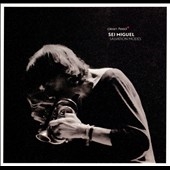
| フォーマット | CDアルバム |
| 発売日 | 2014年04月下旬 |
| 国内/輸入 | 輸入(その他) |
| レーベル | Clean Feed |
| 構成数 | 1 |
| パッケージ仕様 | - |
| 規格品番 | CF295 |
| SKU | 5609063002959 |
構成数 : 1枚
合計収録時間 : 00:55:07
Liner Note Author: Pedro Costa.
Recording information: Estudio Musicorde (01/2005); Lisbon, Portugal (01/2005); Namouche Studios, Lisbon, Portugal (01/2005); Estudio Musicorde (02/2012); Lisbon, Portugal (02/2012); Namouche Studios, Lisbon, Portugal (02/2012); Estudio Musicorde (11/2012); Lisbon, Portugal (11/2012); Namouche Studios, Lisbon, Portugal (11/2012).
Photographer: Sofia Martins.
Arranger: Sei Miguel.
Composer and trumpeter Sei Miguel began making records in the late 1980s after relocating from his native France first to Brazil, then permanently to Portugal. Since the very beginning he has developed a highly individual aesthetic that balances the expansive sonorities of the various instruments he writes for with silence, texture, and space. Improvisation has a primary role in his work, but it is carefully articulated within a scored framework. Nowhere is this more evident than on Salvation Modes issued by Clean Feed. Its three long pieces contain just one new work; the others are earlier unrecorded pieces. The 27-minute opener, "Preludio E Cruz de Sala" is played by a quartet including Fala Mariam on trombone, Pedro Gomes on guitar, and Cesar Burago on percussion. It's a long, developmental musical conversation. Instruments assert their individual tonalities in a host of combinations until the 20-minute mark, where they begin to dialogue as a group. As the discussion evolves, the evocation of emotion -- never overstated -- comes forth with tenderness and contemplative awareness. "Fermata," the shortest work here, is nearly ten minutes. Miguel plays finger cymbals in addition to trumpet, accompanied by Andre Goncalves on a manipulated Hammond organ, Margarida Garcia on "twin" (an electrified double bass), and Burago's percussion and radio. The horn is slightly more forceful and lyrical, hovering atop radio static and the skeletal bassline as the percussion finds cracks between various textures and illuminates them. In the last third, an actual blues feel comes through the wash with ghostly organ chords and Miguel's sinewy solo. The final work here, "Cantata Mussurana," is based on a Creole purification ritual. The original French recitative was adapted for Portuguese by vocalist Kimi Djabate, and features an 11-piece ensemble that includes trumpet, two bandoneons, claves, alto saxophone, trombone, trap kit, electric bass, modulated feedback, viola, and guitar. Miguel conducts as well as plays. The anchor is bassist Pedro Lourenco, hovering around the notion of fragmental jazz-funk without ever actually delving into it. The interplay between whammy bar guitar, sax, claves, brushed snare, and vocals is darkly spiritual; the spaces between instruments expand, contract, and blur. As the work becomes denser, more animated, and (slightly) cacophonous around the 12-minute mark, each instrumental voice is heard not only in dialogue with others, but as a separate entity articulated with equanimity, distinct for its own "melodic" purpose in the sheer musicality of this intoxicating whole. Though it would be difficult to choose only one of Miguel's works as a place to begin, Salvation Modes is the one that reveals him at his most imaginative, playful, and artful. ~ Thom Jurek

※ショッピングカートおよび注文内容の確認画面にてフラゲのお届けになるかご確認ください。
※各種前払い決済をご利用の場合、フラゲは保証しておりません。
※フラゲは配送日時指定なしでご注文いただいた場合に限ります。
読み込み中にエラーが発生しました。
画面をリロードして、再読み込みしてください。