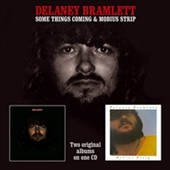
Alas, here we go again, the work of a quintessentially American artist being available only to the nations on the other sides of both ponds. In this case it's the great Delaney Bramlett -- the man who managed to teach Eric Clapton how to sing, wrote one of his biggest hits, and produced his first solo album (anyone who has heard the original version of Clapton's self-titled debut album realizes with great clarity the superiority of Bramlett's version over the officially released one). This is the guy who, along with then-wife Bonnie (who was an Ikette), put together one of the greatest tours this side of the Mad Dogs & Englishmen thang in Great Britain, only to have it stolen by a record company eager to cash in on Clapton's rising star. The album? It's was called On Tour with Eric Clapton by Delaney & Bonnie & Friends. One more thing: Delaney taught Mr. George Harrison how to play the slide guitar because he is a monster on the six-string and plays second to none. Delaney & Bonnie Bramlett issued a handful of albums, including the greatest live-to-tape recorded album in the history of rock & roll: Motel Shot. It was done in a single night in a motel room with all manner of guests, from Mr. Clapton to Mr. Gram Parsons crowding the mikes. In addition, there is the joyous and powerful To Bonnie from Delaney. This pair of sides, Some Things Coming (a classic in its own right) and Mobius Strip, may not rank quite as high in the pantheon of believers as the aforementioned three, but perhaps they deserve to. And they do smoke -- the former with its hard-driving Southern soul meets funk-happy rock band recorded and issued in 1972, and the latter with its larger, more ambitious follow-up in 1973.
Some Things Coming features Bramlett on lead vocals and guitars with a full-on horn section, Venetta Fields and Clydie King on backing vocals throughout, string arrangements by George Bohannon, percussionist Milt Holland, Ronnie Grayson on drums, bassist Robert Wilson, and B-3 boss Tim Hedding -- the backing chorus added on several cuts includes future disco diva Gloria Jones and Shirley Matthews. The material is wide-ranging but always greasy. The opener is the driving funky Southern soul and gospel of "Over and Over"; it's revved to rockist hedonism with a splintering, overdriven guitar and popping bassline dueling to the death with double-time drums and an ambitious horn chart. There's the in-the-pocket ballad "Thank God," which manages to evoke both Ray Charles and '60s Nashville without blowing it. The gospel blues of "Please Accept My Love" is done in the utterly believable, wanton, pleading singing voice that Leon Russell and Bramlett shared -- but Bramlett's range is wider. It gets downright hard and funky on "Keep It Going," a tune that Bramlett co-wrote with Elvin Bishop. This is snaky voodoo funk at its best. One can hear the Meters and a gospel choir meeting on the street corner where Saturday night reluctantly gives way to Sunday morning and the spirits are everywhere duking it out. Add the title track and the album is worth its weight in gold. Bramlett -- via percussionist Holland with a kalimba, congas, and a boatload of hand percussion, and a gospel choir singing in Zulu -- simply takes the innovation of Hugh Masakela into the rock and Southern soul idiom. He answers them, line for line, in English. It all flows together until it erupts in razor-sharp lead guitar lines; funked-out bass and drums are underscored by the B-3 in the middle eight before it gives way again to the chant. It's stunning -- especially considering it's followed here with the traditional "Down by the Riverside," done with so much class you'd swear you were in church, except for maybe that guitar solo. Speaking of which, "Sit Right Down" offers one of the nastiest-sounding National Steel bottleneck guitars ever put in front of a mike in a studio.
Mobius Strip was recorded and released in 1973, during Bramlett's separation from Bo
to be continued...
Rovi