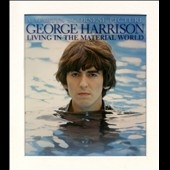
How does an instant multi-million-selling album become underrated? George Harrisons follow-up to All Things Must Pass was necessarily a letdown for fans and critics, appearing after a two-and-a-half year interval without the earlier albums backlog of excellent songs to draw from. Harrison narrowed his sights and his vision for this record, which has neither the bold expansiveness nor the overwhelming confidence of its predecessor. "Sue Me Sue You Blues" seems like a throwback to "Taxman" in its subject matter -- the lawsuit over the similarities between "My Sweet Lord" and "Hes So Fine" -- rather than recalling the spiritual All Things Must Pass. And some of the most serious songs here, such as "The Light That Has Lighted the World," seem dirge-like. What Living in the Material World shows off far better than the earlier record, however, is Harrisons guitar work -- he had Eric Clapton and Dave Mason sharing the guitar chores on All Things Must Pass, but hes the only guitarist on Material World, and it does represent his solo playing and songwriting at a peak. Most notable are his blues stylings and slide playing, glimpsed on some of the later Beatles sessions. "Dont Let Me Wait Too Long" is driven by a delectable acoustic rhythm guitar and has a great beat, both sounds later picked up by Jeff Lynne for ELOs "Livin Thing." The title track benefits from a tight, hard band sound with a great Jim Horn performance on sax; and "The Lord Loves the One (That Loves the Lord)" is the high point of the record, a fast, rollicking, funky, bluesy jewel, with a priceless guitar that may be the best of Harrisons solo career. "Be Here Now" is nearly as fine a song in the completely opposite vein, a soft, eloquent, hauntingly beautiful piece that quietly (and eerily) recalls Pink Floyds exquisite, languid "Now and Then" from the same year. Vocally, he isnt as self-consciously pretty or restrained here, but it is an honest performance, and his singing soars magnificently in his heartfelt performance on "The Day the World Gets Round." "Try Some Buy Some," the only song produced by Harrison and Phil Spector. and the only number to recall All Things Must Pass sound, doesnt quite fit with the rest of this, although in 1973 it was many peoples favorite song other than the chart-topping "Give Me Love." Perhaps a less serious title -- like "Just George" -- would have represented the album better, but nobody was looking for self-effacement from any ex-Beatle in those days. ~ Bruce Eder
Rovi
How does an instant multimillion-selling album become an underrated minor masterpiece? George Harrisons follow-up to the triple-disc All Things Must Pass (which had been comprised of an immense backlog of great songs that hed built up across the last years of his time with the Beatles), Living in the Material World was necessarily a letdown for fans and critics, appearing as it did two-and-a-half-years after its predecessor without that earlier albums outsized songbag from which to draw. And it does seem like Harrison narrowed his sights and his vision for this record, which has neither the bold musical expansiveness nor the overwhelming confidence of its predecessor. And while there are still some beautiful and delightfully lyrical, charming moments throughout, few of the melodies are as instantly memorable and compelling as those of most of the songs on the earlier record, and some of the most serious songs here, such as "The Light That Has Lighted the World," seem weighed down with their own sense of purpose, in ways that All Things Must Pass mostly (but not entirely) avoided. What Living in the Material World does show off far better than the earlier record, however, is Harrisons guitar work -- unlike the prior album, with its outsized contingent of musicians including Eric Clapton and Dave Mason on guitars, hes the only axeman on Material World, and it does represent his solo playing and songwriting at something of a peak. Most notable are his blues stylings and slide playing, glimpsed on some of the later Beatles sessions but often overlooked by fans.
"Dont Let Me Wait Too Long" is driven by a delectable acoustic rhythm guitar and has a great beat. The title track isnt great, but it does benefit from a tight, hard, band sound, and "The Lord Loves the One (That Loves the Lord)," despite its title, is the high point of the record, a fast, rollicking, funky, bluesy jewel with a priceless guitar break (maybe the best of Harrisons solo career) that should have been at the heart of any of Harrisons concert set. Vocally, Harrison was always an acquired taste, and he isnt as self-consciously pretty or restrained here, but it is an honest performance, and his singing soars magnificently in his heartfelt performance on "The Day the World Gets Round," a song that resembles "Beware of Darkness" and also, curiously enough, "Across the Universe." Perhaps a less serious title would have represented the album better, but nobody was looking for self-effacement from any ex-Beatle except Ringo (whos also here, natch) in those days. Even in the summer of 1973, after years of war and strife and disillusionment, some of us were still sort of looking -- to borrow a phrase from a Lennon-McCartney song -- or hoping to get from them something like "the word" that would make us free. And George, God love him, had the temerity to actually oblige, to the extent of painting a few signs here and there suggesting where hed found it and where we might, all with some great playing and some laughs. And it wasnt all serious -- there are pointed moments of humor throughout, especially on the title song; and "Sue Me, Sue You Blues" was a follow-up to Beatles-era tracks such as "Only a Northern Song," dealing with the internal workings and business side of his lingering involvement with the group, in this case the multiple, overlapping, sometimes rotating lawsuits that attended the breakup of their organization. And one track, "Try Some, Buy Some," which hed given away to Ronnie Spector at the time, actually dated back to the All Things Must Pass sessions. ~ Bruce Eder
Rovi