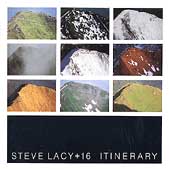
| フォーマット | CDアルバム |
| 発売日 | 2001年12月31日 |
| 国内/輸入 | 輸入 |
| レーベル | HatART |
| 構成数 | 1 |
| パッケージ仕様 | - |
| 規格品番 | 6079 |
| SKU | 7619925607923 |
構成数 : 1枚
合計収録時間 : 00:53:05
Steve Lacy + 16: Steve Lacy (soprano saxophone); Urs Leimgruber (soprano & tenor saxophones); Steve Potts (alto & soprano saxophones); Klaus Peham (trumpet); Franz Koglmann (flugelhorn); Glenn Ferris, Radu Malfatti (trombone); Raoul Herget (tuba); Andreas Kolbe (flute, piccolo); Hans Steiner (bass clarinet); Irene Aebi (cello, violin, vocals); Gyde Knebusch (harp); Bobby Few (piano); Burkhard Stangl (guitar); Jean-Jaques Avenel (bass); John Betsch (drums); Sam Kelly (percussion).
Producers: Ingrid Karl, Pia, Werner X. Uehlinger.
Recorded at Haus Der Begegnung Mariahilf, Vienna, Austria on November 26-28, 1990. Includes liner notes by Art Lange.
Personnel: Steve Lacy (soprano saxophone); Irene Aebi (vocals, violin, cello); Burkhard Stangl (guitar); Gyde Knebusch (harp); Steve Potts (soprano saxophone, alto saxophone); Urs Leimgruber (soprano saxophone, tenor saxophone); Klaus Peham (trumpet); Franz Koglmann (flugelhorn); Glenn Ferris, Radu Malfatti (trombone); Raoul Herget (tuba); Bobby Few (piano); John Betsch (drums); Sam Kelly (percussion).
Liner Note Author: Art Lange.
Recording information: Haus Der Begegnung Mariahilf, Vienna, Austria (11/26/1990-11/28/1990).
Recorded at the Listen to Lacy festival in Vienna, 1990, this large ensemble recording is really the Steve Lacy Sextet plus ten. One of the dectet members is Franz Koglmann. Although some of Lacy's other large group experiments met with mixed results, it is not so here. Itinerary, with its seven selections, is an orchestral work on par with at of Gil Evans' (to whom this record is dedicated) Out of the Cool sessions for Impulse, and of course the Gil Evans and Ten recordings that Lacy played on. This is Lacy as composer and arranger in the most classical sense of the word -- despite the improvisation here. All dissonances are controlled, individual pieces (such as "Sweet 16") that are written for the atmospherics that only an orchestra -- even a chamber orchestra such as this one -- can conjure, even if it was based on a 16-note theme used in music workshops that Lacy conducted. There is a joy in these proceedings, as if both leader and musicians express genuine surprise at the shades and textures of complex harmonics that nourish soundtrack statements and generate near marching band exuberances and open-ended, nuanced shapes and colors that make up the great portion of these selections -- particularly the starkly contrasted "The Sun" and "The Moon," which are mirrors of each other in composition, improvisation, and feeling. And that's it, isn't it? What it comes down to is feeling. With the various timbres and modal inventions that erupt from Lacy's charts, feeling is at their root, an optimism that expresses music as an end to transformation, a manner of transferring the emotion necessary to conceive change. And on Itinerary, Lacy juxtaposes numerous kinds of music to achieve that end: European classical music and its 20th century cousin, free blowing, sweetly swinging group and individual approaches to the entire history of jazz, film, and even poetry. This is a side of Lacy no one had ever heard before, and it's too bad it's not a direction he continued to pursue on a larger scale over a longer period of time. These recordings may be over a decade old, but they still point the way to a bright and shining musical vision for the future. ~ Thom Jurek
録音 : ステレオ (Studio)
読み込み中にエラーが発生しました。
画面をリロードして、再読み込みしてください。