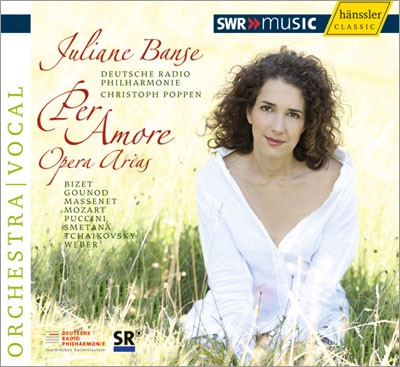
大人気の名花バンゼがhaensslerに登場! 甘美!絶美!名オペラ・アリア集
清楚な歌声と、容姿端麗でコンサートにオペラにひっぱりだこの人気ソプラノ、ユリアーネ・バンゼがhaensslerに登場。それも、まるごと一枚、オペラの名アリアばかりがたっぷりと収められ、バンゼの魅力全開の内容となっています。「わたしのお父さん」「わたしの名はミミ」といったプッチーニのナンバー、グノーの「宝石の歌」と選曲もたいへんチャーミングなこのアルバム。ここで万全のサポートを務めるのはバンゼの夫君ポッペン率いるドイツ放送フィルハーモニー。まさに「婦唱夫随」という趣きの仕上がりとなっております。
キングインターナショナル
発売・販売元 提供資料(2010/12/08)
This album by soprano Juliane Banse features classics of the lyric soprano repertoire. Banse's voice is a true example of what a lyric soprano's voice should be: full, rich, open, and even at times quite powerful (especially on the high notes). And, fortunately, Banse has excellent technique that never breaks or thins, as well as diction that always clearly renders the texts. Thus, in discussing a musician of Banse's stature, one must assess the artistry in detail, given that the fundamentals are so strongly in place. Perhaps her least musically strong arias are the Mozart ones; the characters are interpreted rather on the calm side. Fiordiligi could stand to be more dramatic and her aria taken at a faster tempo (though the melisma is perfectly executed), and the Countess could have more energy, especially in her recitative, which could be more impassioned. Part of this may be the result of the orchestra being conducted at a slightly slow tempo. As Banse's native tongue is German, the arias sung in German come across as the most carefully phrased and emotionally connected. "Wie nahte" is tender, reverent, and pure. "Endlich allein," which was originally written in Czech, gives the listener a sense of darkness and fervor, that she is indeed alone and grieving. Banse undertakes Tchaikovsky's notoriously difficult "Tatiana's Letter Aria," and it is evident that the Russian language suits her voice well. However, one might say that the aria needs a more intimate, girlish quality that captures the Russian sense of melancholy that pervades so much of their music and literature, rather than Banse's more energetic, powerful interpretation. The Italian arias, "Mi chiamano Mimi" and "O Mio Babbino Caro" showcase Banse's lovely sound and also her power. But here, too, one senses the need for more connection to the phrases and the emotions of the character. The last three pieces are sung in French, which also seems to suit Banse's voice very well. One certainly hopes she will perform the entire role of Micaela, as "Je dis que rien" truly convinces the listener she is terrified, but must seek her beloved Don Jose. "Ah, je ris" (or "The Jewel Song," as it is more commonly known) shows a very expressive side of the artist and her capability of singing with great passion. In sum, Banse has a gorgeous voice and gives some very good interpretations. The sound quality could use some improvement, as the album plays somewhat softly.
Rovi