Rolling Stone - "The sound, on tracks like 'Old Man' and 'The Needle and the Damage Done,' was Americana stripped down and rebuilt with every jagged edge exposed."
Rolling Stone (12/11/03, p.114) - Ranked #78 in Rolling Stone's "500 Greatest Albums Of All Time" - "...Americana - steel, guitar, slide guitar, banjo - stripped down and rebuilt with every jagged edge exposed..."
Q (7/00, p.141) - Included in Q's "The Best Male Angst Albums Of All Time" - "...The showcase for [his] most affecting artistic devices..."
Mojo (Publisher) (11/01, p.150) - "...If he was laid-back at this time it was simply because spinal surgery had made him literally so..."
NME (Magazine) (10/2/93, p.29) - Ranked #60 in NME's list of the 'Greatest Albums Of All Time.'
NME (Magazine) (9/18/93, p.19) - Ranked #22 in NME's list of the 'Greatest Albums Of The '70s.'
Rovi
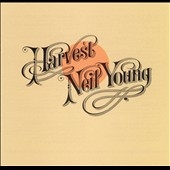
Harvest sits at the foundation of Neil Youngs legacy, a blockbuster that turned the singer/songwriter into a superstar in his own right. He had already received a boost from being recruited into Crosby, Stills & Nash, with After the Gold Rush climbing into the Top Ten months after CSN&Ys Deja Vu went to number one, but Harvest was something different, simultaneously slicker and more eccentric than its predecessor. Its overwhelming success -- thanks to the number one hit "Heart of Gold," a sun-bleached country-rocker that opened up the highway for the likes of America, and becoming the biggest-selling record of 1972 -- camouflages its slightly misshapen structure. Much of the music does indeed fulfill the rural promise of its title, either by relying upon the studio polish of Nashville cats or the ragged ramble of Youngs jerry-rigged California barn. These are complementary approaches, with the raw immediacy of "Are You Ready for the Country," "Alabama," and "Words" contrasting nicely with the burnished, mellow simmer of "Out on the Weekend," "Harvest," and "Old Man." Where Harvest gets a bit odd is on "A Man Needs a Maid" and "Theres a World," where the London Symphony Orchestra plays bombastic arrangements by Jack Nitzsche -- arrangements so overwhelming they threaten to knock the entire album off of its axis. "The Needle and the Damage Done," a lament for the late Crazy Horse guitarist Danny Whitten that was recorded in concert, helps bring Harvest back to earth, offering open-hearted empathy that loses none of its poignancy over the years. At first, "The Needle and the Damage Done" doesnt quite seem to jibe with the rest of Harvest -- its a solo acoustic number recorded live in concert, an aesthetic thats far away from either the slick studio craft or downhome country-rock of the rest of the record -- but its inclusion underscores how Harvest touches upon everything Neil Young had done to that point. Here, hes heard as a folk troubadour and a shaggy rocker, a protest singer and an old soul, a hippie who wants to get back to the country -- all personas hed continue to explore and expand over the course of his career, and all presented here in a way thats welcoming, not alienating. Young notoriously bristled at this accessibility, writing in the liner notes of Decade that "Heart of Gold put me in the middle of the road. Traveling there soon became a bore so I headed for the ditch," but that doesnt erase the fact that Harvest is a remarkable accomplishment, turning Youngs idiosyncrasies into something commercial without sacrificing their substance. ~ Stephen Thomas Erlewine
Rovi
Neil Youngs most popular album, Harvest benefited from the delay in its release (it took 18 months to complete due to Youngs back injury), which whetted his audiences appetite, the disintegration of Crosby, Stills, Nash & Young (Youngs three erstwhile partners sang on the album, along with Linda Ronstadt and James Taylor), and most of all, a hit single. "Heart of Gold," released a month before Harvest, was already in the Top 40 when the LP hit the stores, and it soon topped the charts. Its fair to say, too, that Young simply was all-pervasive by this time: "Heart of Gold" was succeeded at number one by "A Horse with No Name" by America, which was a Young soundalike record. But successful as Harvest was (and it was the best-selling album of 1972), it has suffered critically from reviewers who see it as an uneven album on which Young repeats himself. Certainly, Harvest employs a number of jarringly different styles. Much of it is country-tinged, with Young backed by a new group dubbed the Stray Gators who prominently feature steel guitarist Ben Keith, though there is also an acoustic track, a couple of electric guitar-drenched rock performances, and two songs on which Young is accompanied by the London Symphony Orchestra. But the album does have an overall mood and an overall lyric content, and they conflict with each other: The mood is melancholic, but the songs mostly describe the longing for and fulfillment of new love. Young is perhaps most explicit about this on the controversial "A Man Needs a Maid," which is often condemned as sexist by people judging it on the basis of its title. In fact, the song contrasts the fears of committing to a relationship with simply living alone and hiring help, and it contains some of Youngs most autobiographical writing. Unfortunately, like "Theres a World," the song is engulfed in a portentous orchestration. Over and over, Young sings of the need for love in such songs as "Out on the Weekend," "Heart of Gold," and "Old Man" (a Top 40 hit), and the songs are unusually melodic and accessible. The rock numbers, "Are You Ready for the Country" and "Alabama," are in Youngs familiar style and unremarkable, and "Theres a World" and "Words (Between the Lines of Age)" are the most ponderous and overdone Young songs since "The Last Trip to Tulsa." But the love songs and the harrowing portrait of a friends descent into heroin addiction, "The Needle and the Damage Done," remain among Youngs most affecting and memorable songs. ~ William Ruhlmann
Rovi