ギリシャの偉大な女流作曲家を讃える白熱のライヴ
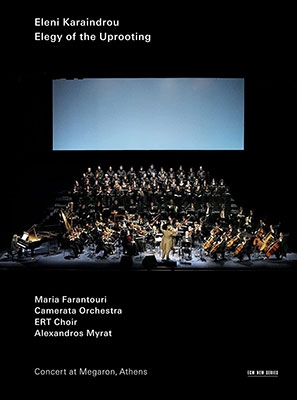
舞台と映画のために様々な音楽を書いてきたギリシャの女流作曲家、エレニ・カラインドルーの業績を讃えて、アテネのコンサート・ホールで開かれたライヴの記録。オーケストラ、合唱、ギリシャの伝統楽器によるアンサンブル、数多くの独奏者に加え、作曲者自身もピアノで参加しています。演目は全てカラインドルーの代表作で、このコンサートのために新たに彼女自身がアレンジし直した形で演奏されています。
カラインドルーの故郷、アテネで3日間にわたって行われたこのコンサートはギリシャ国内はもちろん、ヨーロッパ中で話題となり、チケットはソールド・アウト。コンサート後の評も非常に高く、2006年にリリースされたこのコンサートのCDも大きな話題を呼びました。「全滅、出国、流浪そして帰郷」カラインドルーはこのテーマを今までもその音楽の中で語り続けてきました。一流アーティストたち(ECMのマンフレッド・アイヒャーもアーティスティック&ミュージカル・ディレクターとして参加)により演じられたこの一大叙事詩でもまたこのテーマが繰り返されます。過去のECM作品に現れたモチーフが次々に再現され、まさに彼女の音楽人生すべてをかけて訴えられてきたメッセージが浮き彫りになります。このコンサートの模様が、ついに映像で登場!! [コメント提供;ユニバーサル・ミュージックIMS]
発売・販売元 提供資料(2009/04/08)
As a composer, Eleni Karaindrou may not be a name as widely known in America as Steve Reich or Philip Glass or even John Rutter. No matter. She should be. Karaindrou has spent the last three decades writing scores for the films of her countrymen, most notably the maverick -- and widely celebrated -- Greek directors Theophilus Angelopoulos, Lefteris Xanthopoulos, and Christoforos Christofis, as well as for stage plays (Trojan Women, based on Euripides), and her own major work, "The Great Vigilance," from 1971. These are just to name a few. Her film scores number 20, and she's written more than 40 for theater and television productions. In addition to the Greek directors, she has also collaborated with Harold Pinter and Margarethe von Trotta, among others. Pardon the pedestrian explanation, but Karaindrou doesn't write "soundtrack music." She writes scores. She is as serious and as involved a composer as Mahler, Ustvolskaya, or Part. Elegy of the Uprooting is a double-disc live recording from her label, ECM. It was recorded in performance in Athens, with the composer playing piano, with an group numbering 110 musicians that included the Camerata Orchestra conducted by Alexandros Myrat, the Hellenic Radio and Television Choir, and a traditional instruments ensemble. Despite the presence of so many, there is nothing in this music that is overblown or bombastic. Instead, she follows her compositional dictum and understates everything so that the emotion comes out of the music. It resets a great deal of Karaindrou's music, from all phases of her career, in a context that is glorious and full of beauty, tragedy, myth, movement, and displacement -- she calls it a "scenic cantata."
The music found here comes from her cinematic scores -- Weeping Meadow, Eternity and a Day, Ulysses' Gaze, The Suspended Step of the Stork, The Beekeeper, Landscape in the Mist (all films directed by Angelopoulos), Christofis' Rosa, Happy Homecoming Comrade by Xanthopoulos, and the music from The Price of Love, a theatrical production of Chekov's The Seagull, produced by Julie Dassin. That all of this music can be seamlessly articulated as a single work, covering her most basic themes -- love, exodus, loss, tragedy, and homecoming -- is not only a testament to the composer but to the place in Greek cultural history she has embraced, celebrated, and been woven inseparably into. The recording itself is perfect. The sound is full, warm, rich, and lush even in its spare moments. It is dramatic, not melodramatic. It is restrained in places to bring out in the listener a kind of unbearable longing for resolution, yet it is resolved in itself. It never needs more than it provides. The singers are all top of the board, especially soloist Maria Farantouri. She worked with Karaindrou on Trojan Women and was fully integrated into this project. Attempting to describe the singular sound that comes from many sources is all but ridiculous. Suffice to say it uses folk forms, the classical tradition in the West and East, and even Orthodox liturgical notions to create something otherworldly, out of time and space; it is so utterly sophisticated as to sound simple, and will appeal to anyone who has blood instead of sawdust flowing through her or his veins. Karaindrou is a giant. In her quiet way she towers over more popular figures, simply by digging through the historical, cultural, and musical past, through the images brought forth by them, and by the poetics of the human heart. There is no hollow sentimentality in this work. In fact, it is stripped of that artifice to reach the purity of emotion, presented by a composer and musicians who understand restraint, allowing the story presented here to reveal itself, not by narrative so much as by context and the honesty of the music itself. Without doubt, this is the modern classical recording of 2006 and will go down as a classic in the field. [ECM issued a companion DVD in 2008.] ~ Thom Jurek|
Rovi