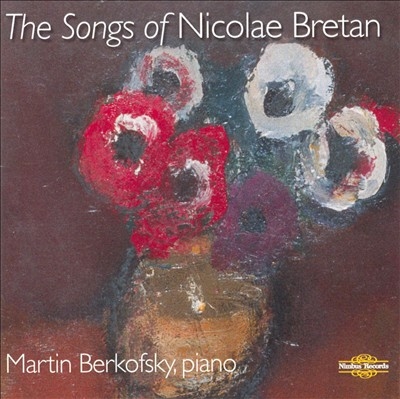
Romanian composer Nicolae Bretan was in a sense a man without a country; considered Romanian as he lived and worked in Romania for the balance of his career, Bretan was born in Hungary and fluent in a bouquet of Eastern European languages in addition to German. That he was a composer of art songs is of interest, as his work in the genre -- collected into a single volume containing 218 songs -- reflects his various contacts and interests in Eastern European culture and the German-speaking world that, at the outset of his long life, were all considered part of the Austro-Hungarian Empire. Nimbus Records, which for more than a decade has served as the flashpoint for all things Nicolae Bretan, has put forth a serviceable selection of Bretan's songs as sung with enthusiasm and no small amount of artistry by Romanian bass-baritone Alexandru Agache on The Songs of Nicolae Bretan. Pianist Martin Berkofsky provides solid, but sensitive support to Agache throughout.
This collection features 24 songs variously in Romanian, Hungarian, and German; some are based on folk songs and others on settings of poets in those languages. Certain songs do stand out, mainly because of their artful exposition of folk forms, such as "Casa Noastra" (Our House), which has a distinct Hebraic tincture, and "Si Daca Ramuri Bat In Geam" (The Rain Beats Against the Windows), reflecting Magyar song as it was once delivered in the cabarets and restaurants of Budapest. However, like Bretan's operas -- which Nimbus has also recorded -- these songs do not seem to convey a specific identity from the standpoint of the composer. Bretan's songs are all accomplished, but from an experiential perspective are not very dynamic; the main ingredient they all seem to share is a kind of flavorlessness, like unseasoned food. One appreciates the enthusiasm of annotator Hartmut Gagelmann, in excerpts from his book on Bretan, in endorsing these songs as a kind of antithesis to the more expansive and typically through-composed orchestral lieder of Wagner and Mahler. However, the lack of dates provided for any of these songs makes it hard to contextualize them, or for Gagelmann to prove his thesis. One could just as easily argue that works such as the Wesendonck Lieder or Lied von der Erde do not represent the mainstream of lied composition in their time, and composers such as Hans Werner Henze and Wolfgang Rihm would definitely take issue with Gagelmann's notion that the lied in Europe perished with Richard Strauss' Vier Letze Lieder.
Nevertheless, Gagelmann's comparisons of Bretan's work to German lied seem a bit off the mark. So many of these songs have a strong Slavic character; they are a little reminiscent of Mussorgsky's songs, though are far less harmonically involved and yet are not plain enough to achieve the evocative through the use of negative space, a hallmark of lied going back to Schubert. Bretan's songs might be of interest to those who have an inexhaustible appetite for Eastern European melody, but they will seem like small beer to connoisseurs of lieder. That said, any excuse to listen to the marvelous voice of Alexandru Agache is still a good one.
Rovi