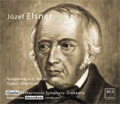
The name of Jozef Elsner is hardly a familiar one outside of Poland, and perhaps not even within its borders. He is considered the patriarch of Polish music and served as teacher to countless Polish composers, including Chopin, who Elsner called "an exceptional talent, a musical genius." Elsner enjoyed an exceptionally long life for a man of his era; he was born the year before Beethoven and died the same year Janacek was born. With all of that time to live and the wide swath of musical history that Elsner's lifespan cuts through, one would expect that his music would form a bridge between the late classical and early romantic periods, but like the bridge in Avignon, it only goes part of the way across, its surviving section resting primarily on the "classicist" shore. At least this is the impression one gets from the featured work on the first CD devoted to a substantive selection of Elsner, Dux's Jozef Elsner: Symphony in C major.
The word "surviving" is an important one in this case -- Elsner composed eight symphonies, but only two still exist, a B flat major effort from 1818 and the Symphony in C major, Op. 11, heard here, dating from 1805. The overwhelming majority of his efforts were devoted to opera and solo songs, most in Polish, and apart from the later symphony and a septet dating from 1830, Elsner's instrumental output dries up right about 1805. The Symphony in C is an interesting hybrid of classical symphony with a touch of early romantic style -- the first movement draws quite a bit of inspiration from Beethoven, and at 10-and-a-half-minutes is longer than the average symphonic movement of 1805. Remember, this is the year Beethoven started composing his famous Symphony No. 5 in C minor. However, the remaining movements are in a mold taken straight from Haydn; the third-movement minuet sounding like "bad" Haydn, except that Haydn probably never wrote a minuet as bad as this one. Overall, though, the symphony is a pretty impressive outing for a composer as provincial as Elsner. By birth he was Silesian, and prior to being named director of the opera in Warsaw, he studied in Breslau (not music, incidentally) and had served as a musician in Brno and L'viv -- cities hardly in the mainstream of music in his day. Perhaps there is no reason to mourn the loss of Elsner's missing six symphonies; while it is apparent he could write them, and was responsive to current trends in music, the form was simply not his forte.
The four opera overtures included as filler to the symphonies, however, are a different matter entirely -- they are thoroughly delightful, even magical in their effect. Furthermore, one is really made curious about these operas as a whole -- who wouldn't want to hear Sultan Vampum, the opera seria Andromeda, or Leszek the White? The overtures are quite varied in style. The curtain raiser to Sultan Vampum, dating from 1800, is highly dramatic and indulges in violent effects left over from German Sturm und Drang. The overture to Leszek the White (1809) is reminiscent of Rossini and his manner of building up the power of an overture gradually over time, except that in 1809 Rossini hadn't written any operas quite yet. The overture to The Echo in the Wood (1808) demonstrates that Elsner did eventually get a grip on Beethoven's style; it is far more assured in this respect than anything heard in his symphony. The performance of all the music, by the Opole Philharmonic Symphony Orchestra (including all three orchestral designations!) under Boguslaw Dawidow is quite good, and plays these giga-obscure pieces as if they were familiar old classics like Beethoven.
While Dux's Jozef Elsner: Symphony in C major is an interesting and valuable addition to the recorded repertoire, perhaps Dux might reconsider and make us an Elsner disc consisting of opera overtures only? One would love to hear the overture to an opera Elsner composed to a libretto by E.T.A. Hoffman, The Old Dolt and the Young Sage. For anyon to be continued...
Rovi