| フォーマット | CDアルバム |
| 発売日 | 2007年02月27日 |
| 国内/輸入 | 輸入 |
| レーベル | Tzadik |
| 構成数 | 1 |
| パッケージ仕様 | - |
| 規格品番 | TZ7618 |
| SKU | 702397761822 |
構成数 : 1枚
合計収録時間 : 00:40:14
Personnel: Tony Oxley (percussion, electronics); Derek Bailey (guitar).
Recording information: Barbican, London, England; London, England.
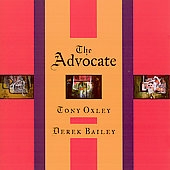
The vast majority of The Advocate's tracks were recorded by the late Derek Bailey (guitar) and Tony Oxley (percussion and electronics) in London in 1975. John Zorn's Tzadik label is releasing this collaboration here for the first time. Oxley had recorded his sublime duo project with multi-instrumentalist Alan Davie earlier that year, and Bailey had just issued his London Concert set on Incus. Both men had been part of Barry Guy's London Jazz Composer's Orchestra and had worked together a decade before in the Joseph Holbrooke Trio with Gavin Bryars. There are three improvisations here: two of them, "Sheffield Phantoms" and "Playroom," are longer pieces clocking in at over ten minutes each, while the brief "Medicine Man" is less than three. To be fair, these are of such a piece as collective free improvisation that they were most likely part of a whole, feeling more like one extended work than three individual ones. They involve Bailey meandering around the strings, plucking, scraping, scratching and haltingly slipping around the guitar like an idea regarded as a series of possibilities more than as a single instrument to be forcefully attacked. Oxley uses the entire drum kit, as well as myriad other surfaces, as something with which to explore the essence of percussion's role in separating space more than something to merely "play" rhythmically. The final track is the title piece and was recorded by Oxley at the Barbican as a memorial to Bailey. His use of electronics ad the drum kit are more "rhythmic," but only insofar as they attempt to extend the reach of percussion as an adornment of space and as an extension of time itself. Here, at over nearly six minutes, cymbals are rung and scraped, drums are rolled on and patted, brushed and nearly caressed as Oxley'as electronic blips and samples and glitches underscore, and perhaps point to Bailey's lack of a guitar as a missing element without attempting to make up for that lack. For those who still look to this point in the mid-'70s as a pioneering moment in improvisational music, the document is more than a curiosity piece; it's a piece of found treasure. ~ Thom Jurek

※ショッピングカートおよび注文内容の確認画面にてフラゲのお届けになるかご確認ください。
※各種前払い決済をご利用の場合、フラゲは保証しておりません。
※フラゲは配送日時指定なしでご注文いただいた場合に限ります。
読み込み中にエラーが発生しました。
画面をリロードして、再読み込みしてください。