Jazz
CDアルバム

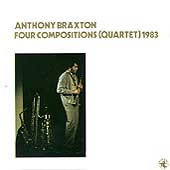
Four Compositions (Quartet) 1983

0.0

販売価格

¥
2,591
税込
還元ポイント

販売中

お取り寄せ
発送目安
7日~21日

お取り寄せの商品となります

入荷の見込みがないことが確認された場合や、ご注文後40日前後を経過しても入荷がない場合は、取り寄せ手配を終了し、この商品をキャンセルとさせていただきます。

フォーマット CDアルバム
発売日 2018年11月23日
国内/輸入 輸入
レーベルBlack Saint (Italy)
構成数 1
パッケージ仕様 -
規格品番 1200662
SKU 027312006629

構成数 : 1枚
合計収録時間 : 00:41:22
Personnel: Anthony Braxton (soprano & alto saxophones, clarinet); George Lewis (trombone); John Lindberg (bass); Gerry Hemingway (percussion).
録音 : ステレオ (Studio)

  1. 1.[CDアルバム]
    1. 1.
      Composition No. 105 A

      アーティスト: Anthony Braxton

    2. 2.
      Composition No. 69 M

      アーティスト: Anthony Braxton

    3. 3.
      Composition No. 69 O

      アーティスト: Anthony Braxton

    4. 4.
      Composition No. 69 Q

      アーティスト: Anthony Braxton

作品の情報

メイン
アーティスト: Anthony Braxton

商品の紹介

Before getting to the music of this Anthony Braxton recording, the listener is confronted with a highly calculated methodology. The album bears the stark title Four Compositions (Quartet) 1983, and each song (itself merely a cataloged number) is accompanied by its own highly cryptic diagram. This sets up a struggle, whereby musical/emotional ends must be achieved through Braxton's analytical compositional means. For this 1983 session, Braxton selected materials from his collection of notebooks to provide the focus for quartet improvisations. The resulting performances lack a sense of continuity. Composed themes are tight, awkward structures delivered by the hornmen with mechanical precision. The improvised sections that follow bear little resemblance (in structure or mood) to any point of origin, rendering irrelevant the themes themselves. What saves Four Compositions is that the musicians are willing to see the composer's ideas through, employing every facility. Braxton gives everyone a great deal of freedom and space. John Lindberg lays down a wonderful bass solo on "Composition No. 69 M," speaking in tongues with clustered, rumbling notes. Elsewhere he adds undercurrents of throbbing, bowed tones. George Lewis has an equally strong grasp of the trombone's possibilities. On the vibrant theme to "No. 69 M," he holds the rhythmic pulses from which Braxton springs forth. Elsewhere, he disguises the horn's recognizable characteristics, opting for sheer sound. Avoiding scattered flurries of free rhythm, Gerry Hemingway dictates with spacious, careful percussion. On "Composition No. 69 Q," he even hints at a stiff, snare-led swing. Among these musicians, Braxton is an equal, stretching from vivid, Middle Eastern-flavored clarinet lines on "No. 69 M" to grittier tenor on "No. 69 Q." According to Braxton, the goal of Four Compositions was to select materials that would comprise a "creative and diversified" album. Yet while the musicians do seem largely free and highly expressive, the Four Compositions themselves feel unbalanced and oddly subdued. Maybe the composer's forethought established too much structure. It seems like there is always a set of imposed elements holding them back. ~ Nathan Bush
Rovi

メンバーズレビュー

レビューを書いてみませんか?

読み込み中にエラーが発生しました。

画面をリロードして、再読み込みしてください。