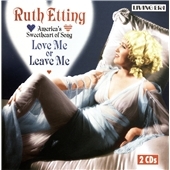
native of David City, Nevada, Ruth Etting began her musical career in Chicago where she developed a style that could be said to epitomize the art of the straight and narrow pop vocal, for she never deviated from the melody or the lyrics as written. This places her in a completely different realm from Billie Holiday; Ruth Etting represented the "normal" approach to singing from which Lady Day deviated so wonderfully. As if to demonstrate the case in point, Living Era's tribute to Ruth Etting opens with her 1928 recording of Walter Donaldson and Gus Kahn's "Love Me or Leave Me," a song that became a jazz standard after Fats Waller recorded it as a stride piano solo in 1929, and underwent remarkable transformations when Billie Holiday and Lester Young reinterpreted it in 1937. A comparison of Etting's and Holiday's approach to the same songs speaks volumes about the parallel arts of jazz and pop singing (examples included here are "Back in Your Own Back Yard," "I'll Get By as Long as I Have You," "Body and Soul," "I'll Never Be the Same" and "It's a Sin to Tell a Lie"). Although remembered as a paragon of the sentimental torch song, Ruth Etting sounded best when delivering pleasantly upbeat numbers like "Button Up Your Overcoat." On this collection, she is backed by excellent jazz musicians like Tommy and Jimmy Dorsey, Benny Goodman, guitarist Eddie Lang, pianists Rube Bloom and Frank Signorelli; trumpeters Charlie Spivak and Manny Klein, and bassman Joe Tarto. Even if she sang like the girl next door, her story reads more like something out of an old Humphrey Bogart movie. During her early days as a Chicago nightclub entertainer, Ruth Etting became the consort and then the wife of mobster Moe "The Gimp" Snyder, a notorious thug who appointed himself as her manager and bulldozed people in the entertainment industry in order to further her career. Throughout the mid-'20s Etting became famous on Broadway, as a radio personality and as Columbia's most popular female recording star. The plot sickened, however, as her few appearances in motion pictures were flummoxed by careless casting and lousy scripts. Her marriage steadily deteriorated under the burden of Snyder's jealous boorishness -- he even gunned down her accompanist Myrl Alderman, who recovered and married Etting after Snyder went to prison. Withdrawing from public scrutiny for a few years, the aging singer attempted a comeback in 1947 and then retired to Colorado where she passed away in 1978. This double-disc portrait of "The Queen of the Torch Singers" proceeds in a more or less chronological manner, from her early recordings made in April of 1926 to her hit records of 1931 and 1932; sweetly stylish stuff presented during the darkest days of the Great Depression. ~ arwulf arwulf|
Rovi