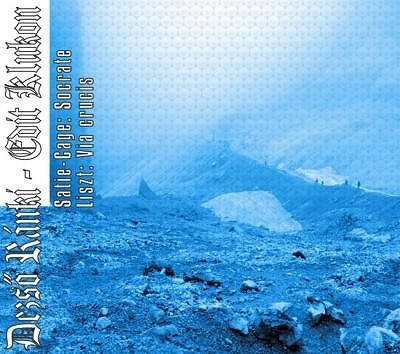
このアルバムの2つの作品を続けて聴いてみると、同じ作曲家の作品のように聴こえるかもしれません。晩年のサティとリストによって書かれたこれらの作品は、共通点を持っておりどちらも音楽表現の華美な手段を最小限に抑え、音楽の核心を伝えようとしているかのような作品です。中世の音楽に立ち戻ることにより、より進歩的な音楽を作り上げています。
東京エムプラス
発売・販売元 提供資料(2022/08/22)
It is hard to imagine a more odd coupling than this; John Cage's four-hand piano arrangement of Erik Satie's "drame symphonique" Socrate paired with Franz Liszt's 1878 suite Via Crucis (The Stations of the Cross) in its four-hand incarnation, original to the composer. Issued by Budapest Music Center, it does not appear that either of these works have been recorded before; the Liszt was not published until 1987, and Cage's arrangement, in part prepared for a dance by Merce Cunningham in the '40s, did not make its bow in print until publisher Max Eschig issued it in 1984. This is significant, as Eschig had blocked production of a full-length dance set to Socrate in 1969, prompting Cage to compose Cheap Imitation instead and thus opening the door to his acclaimed late style of composition.
Despite the oil and water combination that might seem apparent at first glance, these two pieces have a great deal in common musically. Liszt's Via Crucis is rendered entirely in his late style, a lean, anti-virtuosic, proto-modernist idiom retaining only surface elements of Romanticism, and pregnant with a mysterious, and very personal, sense of mysticism. For example, during the movement "Jesus is nailed to the Cross" we hear the hammer blows represented as loud, minor chords, but that is all we hear -- the usual nineteenth century tendency toward added decoration is stripped away. The plainness and simply stated devotion in Liszt's music matches the Satie, whose "drama" taken from Plato typifies a deliberate attempt to create a work so plain that it borders on being non-representational. Cage's arrangement is a thoroughly faithful, no-nonsense, and professionally made rendering in four-hand form from Satie's cantata. For devoted followers of Satie's music who nonetheless cannot bear listening to trained voices singing Socrate in its conventional form, the Cage arrangement will present an obliging alternative.
The four-hand team of Dezso Ranki and Edit Klukon has been playing Via Crucis for years, and while the Cage may be newer to them, the stylistic idiom is not. In a sense, their experience with Liszt's cool and controlled late music prepared them well for the Satie, a realization that would have come as a shock to the ever anti-Romantic Cage, but might have surprised him pleasantly as well. Ranki and Klukon's performances of these pieces are superb, the disc is well-recorded, and as a whole, Satie-Cage: Socrate -- Liszt: Via Crucis is a laid-back, intellectually satisfying program that is well-suited to late-night reading, relaxation, or reflection.
Rovi